Seriously. Why Are Republicans So Dumb?

Grim Reaper

Chief Exit Officer (CEO)

The GOP’s War on Intelligence: From Reagan to Trump, the Republican Party Has Turned Stupidity Into Strategy and Governance Into a Bad Joke​


If you enjoy this article, please share, subscribe, and tap the Buy Me a Coffee button ☕. Your support keeps me fueled to call out the corrupt and complicit.

Subscribe


Buy me a coffee


The Republican Party didn’t stumble into stupidity—it sprinted headlong into it. Over the past half-century, the GOP has transformed itself into a political movement where ignorance isn’t just tolerated—it’s a badge of honor. From Ronald Reagan’s fairy-tale economics to Donald Trump’s clown cabinet, the Republican Party has turned stupidity into strategy and left the rest of the nation grappling with the fallout.

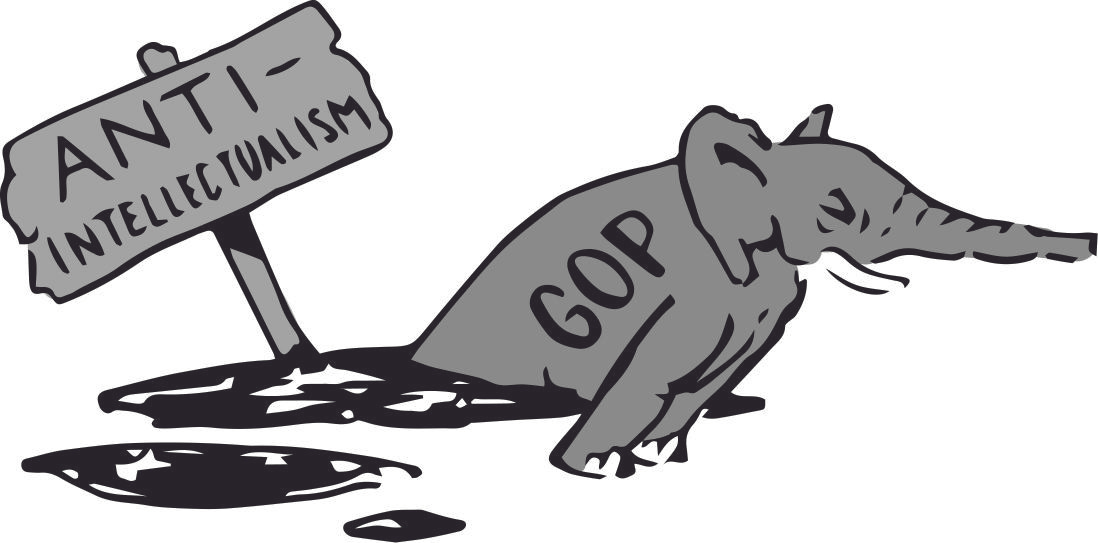
This isn’t just about bad policy or a few misguided leaders. It’s about a deliberate, systemic effort to cultivate and reward ignorance at every level. The result? A feedback loop of stupidity, where the uninformed elect the unqualified, who then enact policies to keep voters uninformed. This dynamic isn’t accidental; it’s deliberate. The GOP’s anti-intellectualism thrives on a vicious cycle: portray intellectuals as 'elitists' out to oppress the common man, elect politicians who embody that rejection of expertise, and then implement policies that ensure voters remain uninformed. The Republican war on education, for instance, isn’t collateral damage—it’s strategy, designed to cultivate a pipeline of anti-intellectual voters and ensure their grip on power.

The GOP is circling the drain, and it’s sucking the country down a spiral of dysfunction.


The GOP Base: Dumb and Proud of It​

The GOP didn’t arrive at this point by accident. Over decades, the party has crafted a narrative that weaponizes resentment and mistrust, transforming education into a badge of elitism, expertise into an oppressive force, and intelligence itself into a threat to be feared and disdained. The result? A base that doesn’t just tolerate ignorance—it demands it.

Today’s notorious figures like Marjorie Taylor Greene, a U.S. Representative from Georgia known for promoting conspiracy theories, and Lauren Boebert, a U.S. Representative from Colorado infamous for her inflammatory antics, aren’t outliers—they’re archetypes. Greene’s absurd claim about Jewish space lasers causing wildfires or her promotion of bizarre QAnon conspiracies isn’t a liability to her constituents—it’s her selling point. Meanwhile, Boebert, known for being booted from a Denver theater during a children’s musical after antagonizing other audience members, vaping, and explicitly groping her companion’s genitals, is hailed by her base as a cultural warrior. Their antics aren’t viewed as embarrassing but as defiant acts of rebellion against “woke elites.” Moreover, they exemplify a larger trend in GOP leadership, normalizing conspiracies and spectacle as political tools.

GOP voters cheer for politicians who ban books and defund schools, only to wonder why their children fall behind in global education rankings. They rail against government overreach while voting for leaders who legislate their personal lives down to the bedroom. For a base this committed to self-sabotage, ignorance isn’t just bliss—it’s doctrine.



Ronald Reagan: Anti-Intellectualism’s Seeds Planted​

Reagan’s presidency didn’t just normalize style over substance—it weaponized it, institutionalizing a deeply anti-intellectual ethos that the GOP has nurtured ever since. This wasn’t just about catchy slogans like “Morning in America” or Reaganomics’ hollow promises; it was about reshaping the national psyche to view intelligence, expertise, and critical thinking as threats to the American way of life.

Reagan’s presidency brought this strategy to American politics in a way that felt innocuous—wrapped in the charm of Hollywood optimism. His administration cut funding for public education while advancing the idea that “government isn’t the solution to our problem; government is the problem.” These policies weren’t just budgetary decisions; they were a deliberate attempt to devalue public institutions and foster skepticism toward education as a means of empowerment. By starving schools and universities of resources, Reagan ensured that future generations would have less access to the tools of critical thinking and upward mobility.

Simultaneously, Reagan championed deregulation and supply-side economics, sold to the public with oversimplified, feel-good narratives like “trickle-down economics” that ignored their devastating long-term consequences. Economists widely criticized these policies for enriching the wealthy while stagnating middle-class wages and deepening inequality—warnings Reagan’s administration willfully ignored.

During the AIDS epidemic, he refused to acknowledge the crisis publicly for years, even as thousands died. This silence perpetuated ignorance, stigma, and fear, enabling the epidemic to spiral out of control. Similarly, scientific warnings about climate change were downplayed or dismissed, ensuring that opportunity for early action was lost. In both cases, Reagan’s ideological priorities triumphed over scientific and medical expertise, with dire consequences.

Slogans like “Morning in America” and the carefully staged imagery of his presidency reinforced a narrative of optimism and simplicity, obscuring the complexities of the issues his administration ignored or mishandled. This wasn’t just a political strategy—it was a cultural shift, teaching Americans to value appearances over understanding.

These attacks on education were not isolated to budget cuts but have since evolved into a broader strategy. Across red states, policies now include banning books, limiting discussions on racism and gender, and defunding public schools. These moves aren’t about protecting children—they’re about keeping voters ignorant and ensuring the next generation is even more susceptible to propaganda. By replacing science and history with ideology, the GOP is deliberately creating a cycle where ignorance fuels its political power. These policies are the direct descendants of Reagan’s framing of public institutions as 'the problem,' reinforcing his ideological legacy.

Reagan deliberately framed intellectualism as a liability, portraying academics and experts as out-of-touch elites disconnected from “real Americans.” By dismissing nuance as weakness and branding education as elitism, Reagan planted the seeds of anti-intellectualism that have since grown into a defining characteristic of the modern Republican Party.



George W. Bush: Sprouting the Roots of Anti-Intellectualism​

If Reagan was the warm-up act, George W. Bush was the main event. His presidency perfected the GOP’s formula of anti-intellectualism disguised as “common sense.” Bush’s folksy, “aw, shucks” demeanor wasn’t just an act—it was his brand.

Bush’s rejection of nuance had catastrophic consequences. His “Axis of Evil” rhetoric, which crudely reduced complex geopolitical dynamics to a black-and-white, good-versus-evil narrative, sidelined seasoned diplomats and foreign policy experts. This oversimplification paved the way for the disastrous invasion of Iraq, a war launched on discredited claims of weapons of mass destruction. The administration ignored the findings of UN weapons inspectors and disregarded dissenting voices within the intelligence community. The war drained trillions of dollars, destabilized the Middle East, and resulted in hundreds of thousands of deaths, all while exposing the dangers of rejecting informed, nuanced debate in favor of ideological certainty.

On the domestic front, Bush’s blind faith in free-market absolutism dismissed clear warnings from economists about the risks of deregulating the financial sector. His administration’s dismantling of oversight mechanisms allowed for the reckless behavior that triggered the 2008 financial crisis. Rather than engaging with economic experts to address growing systemic risks, the administration doubled down on a laissez-faire ideology, leaving millions of Americans to lose their homes, savings, and jobs.

Bush’s disdain for scientific expertise was glaringly evident during Hurricane Katrina. FEMA had been hollowed out under his watch, and its leader, Michael Brown, was an unqualified political appointee with limited emergency management experience. Experts had long warned about the vulnerability of New Orleans’ levee system and the city’s need for robust disaster planning, yet these warnings were ignored. While failures occurred at all levels of government—Governor Blanco and Mayor Nagin also faced significant criticism for delayed evacuation orders and inadequate preparation—the federal response under Bush was woefully inadequate. The administration’s disorganized efforts left New Orleans devastated and thousands of lives in ruin. Bush’s infamous praise—“Brownie, you’re doing a heck of a job”—became a symbol of his administration’s indifference to competence and expertise.

This strategy is most visible today in red states, where voters consistently support policies that undermine their own interests. From defunding public schools to opposing universal healthcare, these voters are trapped in a feedback loop of misinformation and manipulation. Policies designed to limit critical thinking—whether through book bans or ideological curricula—ensure that future generations remain politically malleable, perpetuating a cycle of self-sabotage.

Bush wasn’t just a bad president—he was a blueprint for anti-intellectual governance. His administration taught the GOP that you didn’t need expertise—just unwavering loyalty to the party line. You didn’t need to solve problems—you just needed a catchy slogan and someone to blame. From “Mission Accomplished” banners to scapegoating scientists, the media, and public institutions, Bush’s presidency paved the way for the GOP’s full embrace of anti-intellectualism, laying the foundation for the chaos of the Trump era.



Donald Trump: Anti-Intellectualism’s Rotten Harvest​

Trump’s war on intellect is a textbook example of fascist strategy. Like autocrats before him, Trump capitalized on a base conditioned to see intelligence as elitism and expertise as oppression. His disdain for science, education, and journalism isn’t accidental—it’s intentional. By rejecting complexity and fostering division, Trump built a movement where fear, ignorance, and loyalty reign supreme.

The tactics are clear and chillingly familiar. Fascist regimes have historically relied on anti-intellectualism to erode trust in institutions, dismantle democratic norms, and consolidate power. They demonize intellectuals and experts, labeling them as conspirators or agents of oppression. They replace evidence with slogans and complexity with simplistic narratives. And they present themselves as the only solution to the chaos they’ve sown.

Trump embodies this approach. His dismissal of climate change, his rejection of public health measures, and his embrace of conspiracy theories are not random—they’re calculated. Each act chips away at the foundations of truth and critical thinking, leaving the public more malleable to his whims. This isn’t governance—it’s the erosion of democracy itself.

As Trump prepares to take office again, his 2025 cabinet selections amplify this strategy. He’s not just rejecting expertise—he’s replacing it with sycophants and ideologues whose loyalty is their only qualification. From anti-vaccine crusader Robert F. Kennedy Jr., selected to lead the Department of Health and Human Services, whose baseless conspiracy theories endanger public health, to Pete Hegseth, a TV teleprompter reader with no military or administrative experience chosen for Secretary of Defense, Trump’s picks epitomize unqualified anti-intellectualism. Pam Bondi, infamous for taking bribes from Trump to ignore his corruption, as Attorney General, and Kash Patel, a QAnon-engulfed conspiracy theorist with no law enforcement credentials, for FBI Director, threaten to politicize justice and law enforcement.

Tulsi Gabbard, known for legitimizing dictators and amplifying disinformation, is poised to dismantle the intelligence community as Director of National Intelligence. Chris Wright, a fossil fuel executive selected for Secretary of Energy, signals the GOP’s continued contempt for environmental science. In education, Linda McMahon, utterly unqualified and bent on promoting religious indoctrination over learning, as Secretary of Education, signals the death of critical thinking and equity in public schools.

Trump’s 2025 cabinet isn’t just inexperienced—it’s a deliberate, full-scale assault on expertise, replacing competence with sycophants to dismantle democratic norms and consolidate power. Each appointment reflects a GOP fully untethered from governance, driven by ignorance, blind loyalty, and authoritarian ambition. The seeds of anti-intellectualism planted by Reagan, nurtured by Bush, and weaponized by Trump have now borne fruit—a cabinet that doesn’t merely reject intelligence but actively weaponizes that rejection as a tool for domination.

The harvest is in, and it is rotten.

[For a scathing critique of all Trump’s cabinet nominees, see one of my recent articles via this link. You can also find my deep-dive take-downs of Bondi, Gabbard, Hegseth, Kennedy, McMahon, and Oz on my Substack homepage.]


A Nation Held Hostage by Ignorance​

The GOP’s war on intelligence has transformed American politics into a theater of distraction, prioritizing culture wars over existential challenges. While other nations invest in education, sustainability, and innovation, Republican leaders obsess over banning books, targeting educators, and railing against imaginary threats like transgender individuals. This fixation on spectacle over substance serves only to obscure the failures of their policies and the dangers of their ignorance.

America cannot compete globally, address its challenges, or protect its democracy while governed by a party that glorifies ignorance and rejects expertise. Every moment we allow this anti-intellectualism to dominate, we edge closer to collapse. The time to resist this assault on intelligence isn’t tomorrow—it’s now.


A Call to Action: Reclaiming Democracy from Ignorance​

The Republican Party’s embrace of ignorance isn’t just their problem—it’s a threat to all of us. Democracy depends on an informed electorate, and the GOP’s strategy of glorifying anti-intellectualism undermines the very foundation of the republic. Passivity is no longer an option. The moment to act is now.

Even with Trump set to assume office for a second term, the power to push back remains in the hands of the people. Here’s how we can fight back:

  1. Stay Informed and Combat Misinformation: Seek reliable information from credible sources, fact-check provocative claims, and calmly confront misinformation online, in conversations, and in your community.
  2. Engage Locally: Attend city council and school board meetings to influence local policies, and volunteer with grassroots organizations advocating for education, voting rights, and environmental protections.
  3. Protect Voting Rights: Oppose voter suppression laws, advocate for expanded access like mail-in voting, and mobilize others to participate in every election.
  4. Hold Leaders Accountable: Demand transparency by contacting representatives and exposing harmful policies through social media, op-eds, and public forums.
  5. Invest in Education: Support public schools by advocating for funding and resisting censorship, while promoting media literacy to empower younger generations.
  6. Build Bridges: Engage in thoughtful conversations across political divides and focus on shared values like job creation, infrastructure, and public safety to foster dialogue.
  7. Organize for the Future: Join reform movements, support candidates who value truth and expertise, and prepare for elections by building networks and strengthening campaigns.
The stakes couldn’t be higher. The GOP’s war on intelligence is a war on democracy itself, but history proves that determined citizens can prevail. We owe it to future generations to resist the normalization of ignorance and defend democratic norms. The fight isn’t over—let’s rise to the challenge and reclaim our democracy.


Buy me a coffee


Subscribe


Share

If you enjoyed this article, please share, subscribe (a paid subscription would be amazing!), and tap the Buy Me a Coffee button ☕. Your support keeps me fueled to call out the corrupt and complicit.

ADDENDUM

12 Ways the GOP’s Anti-Intellectualism Causes Real-World Harm

The price of the GOP’s anti-intellectualism is statistical—it’s written in lives lost, futures squandered, and a nation diminished. Here’s how their embrace of ignorance creates widespread harm:

1. Climate Change Denial 🌍

  • The Problem: The GOP dismisses the overwhelming consensus of climate scientists, ridiculing renewable energy as elitist and framing sustainability as an attack on “real America.”
  • The Consequence: Hurricanes, wildfires, and floods devastate communities, while the U.S. lags in green energy innovation. Instead of action, we get denial—placing profits over survival.

2. Public Health Crises 🩺

  • The Problem: During COVID-19, GOP leaders amplified pseudoscience, dismissed vaccines, and attacked public health measures as “tyranny.”
  • The Consequence: Preventable deaths skyrocketed in states like Florida, where anti-vaccine rhetoric took hold. The GOP’s rejection of medical expertise now fuels a resurgence of diseases like measles and polio.

3. Attacks on Education 📚

  • The Problem: By banning books, censoring discussions of race and gender, and framing educators as indoctrinators, the GOP undermines intellectual growth.
  • The Consequence: Students in states like Texas and Florida are denied a comprehensive education, leaving them unprepared for modern challenges and susceptible to manipulation.

4. Gun Violence Epidemic 🔫

  • The Problem: The GOP ignores decades of research advocating for common-sense gun control, relying instead on myths like “good guys with guns.”
  • The Consequence: Mass shootings continue unabated, as the GOP blocks evidence-based solutions while clinging to ideological narratives.


5. Economic Inequality 💰

  • The Problem: Republicans dismiss economic research showing the harm of wealth concentration, framing redistributive policies as “socialist.”
  • The Consequence: Tax cuts for the wealthy exacerbate inequality, leaving working Americans struggling while stifling broader economic growth.

6. Erosion of Democratic Norms 🗳️

  • The Problem: The GOP promotes election lies, undermines fact-based journalism, and demonizes legal experts to sow mistrust in democracy.
  • The Consequence: Voter suppression laws and baseless conspiracy theories have eroded public confidence in the electoral system, threatening the foundations of democracy itself.

7. Energy Policy Chaos ⚡

  • The Problem: By rejecting environmental scientists and clinging to fossil fuels, the GOP paints renewable energy as impractical and un-American.
  • The Consequence: America falls behind in the global energy race, sacrificing environmental sustainability and economic opportunity for outdated, polluting technologies.

8. Judicial Partisanship ⚖️

  • The Problem: GOP leaders pack courts with ideologues while ignoring legal scholars who warn against dismantling precedent.
  • The Consequence: Decisions like overturning Roe v. Wade destabilize the judiciary, polarize the nation, and undermine trust in the rule of law.

9. Education Curriculum Censorship ✏️

  • The Problem: Censorship of discussions on race, gender, and LGBTQ+ issues reflects the GOP’s disdain for inclusive education.
  • The Consequence: A generation of students is deprived of critical thinking skills and diverse perspectives, leaving them ill-equipped for a globalized world.

10. Disinformation as Policy 📢

  • The Problem: The GOP relies on conspiracy theories and misinformation, rejecting critical thinking for emotional manipulation.
  • The Consequence: False narratives about vaccines, elections, and immigrants fuel violence, confusion, and societal division, undermining governance and trust.

11. Stifling Scientific Research 🔬

  • The Problem: The GOP consistently underfunds research and dismisses scientific consensus in areas like healthcare and climate change.
  • The Consequence: America risks falling behind in global innovation, leaving critical challenges unaddressed and weakening the nation’s future prospects.

12. Global Isolation 🌐

  • The Problem: Republican foreign policy ignores the advice of diplomats and experts, favoring populist grandstanding over nuanced diplomacy.
  • The Consequence: Allies question America’s reliability, adversaries like China and Russia gain influence, and global challenges like climate change remain unresolved.


Buy me a coffee


Subscribe


Resources:​

  1. Profiles in Ignorance: How America’s Politicians Got Dumb and Dumber by Andy Borowitz (2022)
  2. The Education of Ronald Reagan by Thomas W. Evans (2006)
  3. Trump’s Assault on Truth by The Washington Post Fact Checker (2021)
  4. Reagan’s Legacy: The Myth vs. The Reality by The Atlantic (2020)
  5. Bush’s ‘Axis of Evil’ Speech: A Legacy of Simplistic Foreign Policy by Foreign Affairs (2008)
  6. The Death of Expertise by Tom Nichols (2017)
  7. How American Conservatism Came to This by Financial Times Editorial Staff (2016)
  8. Anti-Intellectualism in American Life by Richard Hofstadter (1963)
  9. The Cult of the Amateur by Andrew Keen (2007)
  10. The Republican Brain: The Science of Why They Deny Science and Reality by Chris Mooney (2012)
  11. Reports on the GOP and anti-intellectualism by The Brookings Institution (2022-2024)
  12. American Political Science Association studies on anti-intellectualism (2007-2024)

    Buy me a coffee


    Subscribe


Anti-intellectualism is a social attitude characterized by suspicion, distrust, or hostility towards intellectual pursuits, experts, and academic institutions, often favoring "common sense" over specialized knowledge. It often manifests as populist anti-elitism or religious anti-rationalism, frequently dismissing scientific consensus, research, and critical analysis as detached from everyday life.
 

The war on education: How anti-intellectualism in America is eroding innovation​

The rising distrust of academia has led to American science and innovation being gutted and has set us back several years in research progress.

 
Back
Top