The economic impact of just one immigrant on the US economy

Diogenes

Nemo me impune lacessit
Contributor
Elon_Musk_gesture.gif


WILL YOU HAIL THE WORLD'S MOST INFLUENTIAL AFRICAN AMERICAN?


View: https://x.com/elonmusk/status/1988683361796387133?s=20


Hate-filled JPP leftists who despise an immigrant because Trump, and class warriors like @Freddy Figbottom and @EdwinA don't understand know that quite apart from making himself rich, Elon Musk is a job-creating, tax-paying, economy-boosting force.

Through his companies, Tesla, SpaceX, xAI, The Boring Company, and Neuralink, Musk has funneled hundreds of billions into American pockets over the past five years (2021-2025).

This isn’t abstract Wall Street stuff; it’s real money circulating in communities, from factory floors in Texas to engineering hubs in California. Let’s break it down with hard numbers, showing how Musk’s ventures pump lifeblood into the US economy.

Jobs and Paychecks: Fueling the American Dream​

Musk’s companies have paid out a staggering $110.7 billion in salaries over five years—enough to give every person in Los Angeles a $27,000 check. This cash supports over 200,000 workers at peak, from welders building Cybertrucks to coders dreaming up Mars rockets. It’s not just high-flying execs; average pay hovers around $160,000 at Tesla, keeping families housed, kids in school, and local diners buzzing.

G5kLtuUXQAEQvcB

These paychecks ripple out: Workers spend on groceries, homes, and vacations, multiplying every dollar into $1.50-$2 in local economic activity, per standard multipliers.

Taxes: Musk’s Companies Foot the Bill​

Forget the headlines. Musk’s empire chips in big on taxes.

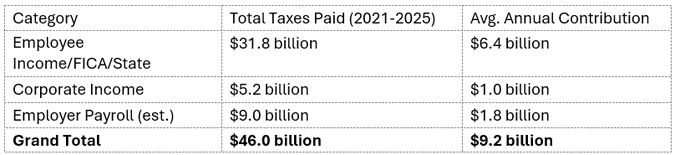
Employees alone shelled out $31.8 billion in income and payroll taxes, funding schools, roads, and Social Security.

That’s like bankrolling the entire US space program twice over.

On the corporate side, the companies paid $5.2 billion in income taxes, despite savvy credits for green tech and R&D.

Add in payroll taxes from employers (~$9 billion), and it’s clear: Musk’s firms aren’t dodging; they’re delivering.
G5kMIn8WUAAtRdR

This tax haul supports public services without the sticker shock—imagine if every billionaire’s ventures did the same.

Suppliers: Building America’s Backbone​

Musk doesn’t hoard; he spreads the wealth to US suppliers.

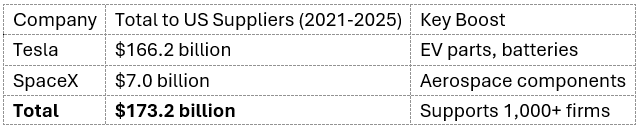
Tesla alone dropped $166 billion on American vendors for batteries, chips, and steel—propping up factories in Michigan and Nevada.

SpaceX, with its “buy American” ethos, added $7 billion, mostly for rocket-grade alloys and avionics from domestic shops.

Together, that’s $173 billion funneled to thousands of small and mid-sized firms, creating indirect jobs and steeling supply chains against global hiccups.
G5kMsiIXUAABCXS

In addition to these expenditures, xAI has spent about $9b in the buildout of their data center, with a further $40 - $60b targeted for Colossus 2 over the next two years.

The Big Picture: A $338 Billion Engine—and Counting​

Add it up: $110.7 billion in salaries + $46 billion in taxes + $182.2 billion to suppliers = over $338 billion injected into the US economy, just since 2021.

These expenditures are set to soar dramatically in the immediate future as Robotaxis, Optimus and Colossus scale, and could reach over $300b per year.

Taking into account the economic multiplier of these expenditures, its like giving the US GDP a turbocharge, all from one visionary’s playbook.

Musk’s impact? It creates high-wage jobs, funds public goods, and rebuilds industrial muscle, proving bold innovation pays dividends for everyday Americans.

Critics gripe about risks or headlines, but the math doesn’t lie.

Musk’s companies are economic dynamos, turning sci-fi into paystubs. As xAI and Neuralink scale, expect even more. In a world of stagnant wages and offshoring, Elon Musk reminds us: American ingenuity still builds the future, and pays for it too.

G5kUcySXcAAc_e1
 
Elon_Musk_gesture.gif


WILL YOU HAIL THE WORLD'S MOST INFLUENTIAL AFRICAN AMERICAN?


View: https://x.com/elonmusk/status/1988683361796387133?s=20


Hate-filled JPP leftists who despise an immigrant because Trump, and class warriors like @Freddy Figbottom and @EdwinA don't understand know that quite apart from making himself rich, Elon Musk is a job-creating, tax-paying, economy-boosting force.

Through his companies, Tesla, SpaceX, xAI, The Boring Company, and Neuralink, Musk has funneled hundreds of billions into American pockets over the past five years (2021-2025).

This isn’t abstract Wall Street stuff; it’s real money circulating in communities, from factory floors in Texas to engineering hubs in California. Let’s break it down with hard numbers, showing how Musk’s ventures pump lifeblood into the US economy.

Jobs and Paychecks: Fueling the American Dream​

Musk’s companies have paid out a staggering $110.7 billion in salaries over five years—enough to give every person in Los Angeles a $27,000 check. This cash supports over 200,000 workers at peak, from welders building Cybertrucks to coders dreaming up Mars rockets. It’s not just high-flying execs; average pay hovers around $160,000 at Tesla, keeping families housed, kids in school, and local diners buzzing.

G5kLtuUXQAEQvcB

These paychecks ripple out: Workers spend on groceries, homes, and vacations, multiplying every dollar into $1.50-$2 in local economic activity, per standard multipliers.

Taxes: Musk’s Companies Foot the Bill​

Forget the headlines. Musk’s empire chips in big on taxes.

Employees alone shelled out $31.8 billion in income and payroll taxes, funding schools, roads, and Social Security.

That’s like bankrolling the entire US space program twice over.

On the corporate side, the companies paid $5.2 billion in income taxes, despite savvy credits for green tech and R&D.

Add in payroll taxes from employers (~$9 billion), and it’s clear: Musk’s firms aren’t dodging; they’re delivering.

G5kMIn8WUAAtRdR

This tax haul supports public services without the sticker shock—imagine if every billionaire’s ventures did the same.

Suppliers: Building America’s Backbone​

Musk doesn’t hoard; he spreads the wealth to US suppliers.

Tesla alone dropped $166 billion on American vendors for batteries, chips, and steel—propping up factories in Michigan and Nevada.

SpaceX, with its “buy American” ethos, added $7 billion, mostly for rocket-grade alloys and avionics from domestic shops.

Together, that’s $173 billion funneled to thousands of small and mid-sized firms, creating indirect jobs and steeling supply chains against global hiccups.

G5kMsiIXUAABCXS

In addition to these expenditures, xAI has spent about $9b in the buildout of their data center, with a further $40 - $60b targeted for Colossus 2 over the next two years.

The Big Picture: A $338 Billion Engine—and Counting​

Add it up: $110.7 billion in salaries + $46 billion in taxes + $182.2 billion to suppliers = over $338 billion injected into the US economy, just since 2021.

These expenditures are set to soar dramatically in the immediate future as Robotaxis, Optimus and Colossus scale, and could reach over $300b per year.

Taking into account the economic multiplier of these expenditures, its like giving the US GDP a turbocharge, all from one visionary’s playbook.

Musk’s impact? It creates high-wage jobs, funds public goods, and rebuilds industrial muscle, proving bold innovation pays dividends for everyday Americans.

Critics gripe about risks or headlines, but the math doesn’t lie.

Musk’s companies are economic dynamos, turning sci-fi into paystubs. As xAI and Neuralink scale, expect even more. In a world of stagnant wages and offshoring, Elon Musk reminds us: American ingenuity still builds the future, and pays for it too.

G5kUcySXcAAc_e1

Musk's factories were paid for by taxpayers, both state and Federal. 'Private' financing didn't get him started, and tax write offs for rich peoples' hobby cars doesn't do shit for the real economy. Robots don't get paychecks, they don't hire anybody, and they don't spend money at small businesses.

Keep trying, though; your dreams of being discovered and adopted by some billionaire looking for new 'house boy' may still come true. Thiel would be your best shot; he's a homo and a big backer of their assorted propaganda outlets, so you could have a job. Competition among all the brown noses is pretty stiff, so have a backup plan.
 
Musk's factories were paid for by taxpayers, both state and Federal. 'Private' financing didn't get him started, and tax write offs for rich peoples' hobby cars doesn't do shit for the real economy. Robots don't get paychecks, they don't hire anybody, and they don't spend money at small businesses.

Keep trying, though; your dreams of being discovered and adopted by some billionaire looking for new 'house boy' may still come true. Thiel would be your best shot; he's a homo and a big backer of their assorted propaganda outlets, so you could have a job. Competition among all the brown noses is pretty stiff, so have a backup plan.

Elon Musk's companies, particularly Tesla and SpaceX, have received substantial government support for their factories and operations, including from taxpayer-funded sources at both state and federal levels. This support comes in forms like tax credits, grants, low-interest loans, reimbursements, and contracts.

Federally, Tesla has accessed loans and credits, such as a $465 million low-interest loan from the U.S. Department of Energy in 2010 for its Fremont, California factory (which was repaid early), and billions in federal tax credits under programs like brainded Biden's hilariously-named Inflation Reduction Act for EV production and battery facilities.

SpaceX's factories and launch sites have been supported by federal contracts totaling tens of billions, including NASA funding for Starship development and Starlink satellites.

Not all of this directly "paid for" factories in full, Edwina. Many incentives are performance-based or tied to job creation, but they significantly reduced costs and enabled expansions that might not have happened otherwise.

Musk's acceptance of government subsidies for companies like Tesla and SpaceX can be defended on several grounds, primarily as strategic investments in innovation, economic growth, and national interests rather than mere corporate handouts. These supports have enabled breakthroughs in electric vehicles (EVs), renewable energy, and space exploration that benefit society at large, while Musk has consistently advocated for a level playing field by calling for the elimination of all subsidies across industries.First, subsidies for emerging technologies like EVs are essential to accelerate adoption and compete globally. Tesla's early access to federal loans, such as the $465 million from the Department of Energy in 2010, helped scale production at a time when the EV market was nascent and risky for private investors alone. This wasn't free money. Musk's company repaid the loan early with interest, demonstrating fiscal responsibility. Without such initial boosts, the U.S. might have ceded ground to foreign competitors, particularly in China, where state-backed EV industries dominate. The result? Tesla has driven down battery costs, created over 100,000 jobs, and contributed to reducing carbon emissions, aligning with broader public policy goals like energy independence and climate action.

Similarly, SpaceX's government contracts and incentives aren't subsidies in the traditional sense but payments for services that save taxpayers money. NASA has awarded billions for launches and crew missions because SpaceX delivers them at a fraction of the cost of legacy providers like Boeing or Lockheed Martin; sometimes 80-90% cheaper per launch. This has revitalized American space capabilities, enabling feats like reusable rockets that lower barriers to space access. Critics overlook how these arrangements foster competition and efficiency, ultimately benefiting the public by advancing national security, satellite tech for global communication (via Starlink), and scientific progress. Musk has emphasized that these are merit-based contracts, not entitlements, and they've positioned the U.S. as a leader in the new space economy.

Musk's stance addresses hypocrisy head-on: he has repeatedly called for ending all government subsidies, including the far larger ones for fossil fuels, which dwarf those for renewables. As he stated, "It has always been Tesla’s view that all subsidies should be eliminated, but that must include the massive subsidies for oil & gas."

This isn't selective opportunism; it's a push for market fairness where innovative, sustainable tech can thrive without artificial props for polluting incumbents. In a 2021 interview, he doubled down on this, arguing that removing EV credits wouldn't hurt Tesla long-term but would disadvantage newer entrants, while oil subsidies perpetuate environmental harm.

Moreover, these incentives are performance-tied, often requiring job creation or milestones, turning them into economic multipliers. States like Nevada and Texas offered tax breaks for Gigafactories in exchange for massive investments and employment booms, injecting billions into local economies.

Far from "welfare," this model exemplifies public-private partnerships that yield high returns—Tesla's market value alone has generated immense wealth, tax revenue, and innovation spillover.

In essence, Edwina, Musk's use of subsidies reflects pragmatic business in a system where governments routinely back high-risk, high-reward ventures to drive progress. His companies have transformed industries, repaid debts, and advocated for subsidy reform, making the case that such support, when used effectively, serves the greater good rather than just one entrepreneur.
 
Musk's factories were paid for by taxpayers, both state and Federal.


Oh, please, Edwina. This tired, brain-dead trope that "Musk's factories were paid for by taxpayers" is the kind of lazy, fact-mangling nonsense peddled by keyboard warriors who wouldn't know a balance sheet from a bedsheet.

First off, your claim is a blatant lie wrapped in exaggeration.

Elon Musk's companies, Tesla and SpaceX chief among them, have poured tens of billions of their own dollars (raised from investors, revenue, and sheer innovation) into building those factories.

Tesla alone has sunk about $44 billion into U.S. manufacturing and infrastructure since its founding, including massive capital expenditures on Gigafactories in Nevada, Texas, New York, and beyond.

That's private money, Edwina, not a taxpayer slush fund.

Last fiscal year? Tesla dropped another $10 billion on capex, with plans for $8 billion more in 2025.

If taxpayers "paid for" these factories, they'd own equity and be cashing dividend checks. Instead, they're getting jobs and tech advancements that nobody else has delivered.

What your laughable claim conveniently ignores, Edwina, is the difference between actual subsidies (like tax incentives or grants) and earned contracts or loans.

For Tesla, government support has totaled around $11 billion over two decades, much of it in the form of EV buyer tax credits under laws like braindead Biden's ludicrously-named Inflation Reduction Act, not direct handouts to build factories, but incentives that boost demand and get repaid through economic growth.

That early $465 million DOE loan? Repaid early, with interest, turning a profit for the government.

SpaceX? It's not sucking subsidies; it's winning competitive bids for NASA and DoD contracts, delivering launches at a fraction of the cost of bloated legacy contractors like Boeing, saving taxpayers billions in the process.

I doubt you're a taxpayer, Edwina.

Every major industry feasts on government support. Oil and gas alone have guzzled over $20 billion annually in U.S. subsidies, totaling trillions globally. You didn't cry about those, di you, Edwina? Don't lie. Unless you can link to posts of yours, I call bullshit.

Apple, Amazon, Microsoft? All top companies lap up billions in incentives. But Y O U singled out the world's most successful African-American, Edwina. Why?

Musk has created 100,000+ jobs (not that he'd hire Y O U, Edwina), and he's paying record taxes (he shelled out $15 billion personally in one year).

Spare me your faggotry, Edwina.

These "supports" are performance-based: meet job targets, get tax breaks. Fail, and they vanish.

Musk's empire delivers ROI that makes Uncle Sam look like a savvy investor, not a chump.

In short, Edwina, your lame claim isn't just wrong; it's willfully ignorant propaganda for low-information people who'd rather rage-farm clicks than face reality.

Musk's factories stand as monuments to private ingenuity, not public charity. If taxpayers truly "paid for" them, we'd all be driving free Cybertrucks by now. Wake up, do some math, and stop embarrassing yourself, if you can.
 
Back
Top