Here's what they were ranked on:
Explore the 2025 CEOWORLD Health Care Index: Taiwan ranks #1 worldwide, with South Korea, Sweden, and Germany in the top 10. Data-driven insights for CEOs and policymakers.

ceoworld.biz
Further down in the page this is listed:
The Health Care Index measures five variables:
- Healthcare Infrastructure – quality and capacity of hospitals, clinics, and networks.
- Medical Professionals – competence and density of doctors, nurses, and health workers.
- Medicine Availability and Cost – accessibility and affordability of essential medicines.
- Government Readiness – ability to respond to crises, regulate effectively, and invest in prevention.
- Environmental & Lifestyle Factors – access to clean water, sanitation, and regulation of health risks.
Now, the Commonwealth study mentioned at the bottom of RD's post measures:
Access to Care focuses on the
affordability and
availability of health services at the population level.
Care Process looks at whether the care that is delivered includes features and attributes that most experts around the world consider to be essential to high-quality care. The elements of this domain are
prevention,
safety,
coordination,
patient engagement, and
sensitivity to patient preferences.
Administrative efficiency focuses on measures of the challenges doctors have in dealing with insurance or medical claims issues; requirements for providers to report clinical or quality data to governmental agencies; and patients’ time spent resolving medical bill disputes and completing paperwork.
Equity reflects how people with below-average and above-average incomes differ in their access to health care and their care experience
Health outcomes reported here refer to those outcomes that are most likely to be responsive to health care interventions.
Care process is the only measure of the quality of the health care system itself. Everything else is administrative or measuring how socialized the system is. In terms of actual care Commonwealth lists the US as #2. But because the US doesn't have a socialized, universal, healthcare system it is heavily penalized by the rest of the measures in this study.
When those advocating for universal, government run, healthcare in the US use this study they are in effect, presenting a Pygmalion. That is, they are presenting a study that awards universal government run healthcare with high marks and systems that don't do that with low ones. Thus, they are arguing from a self-fulfilling prophecy.
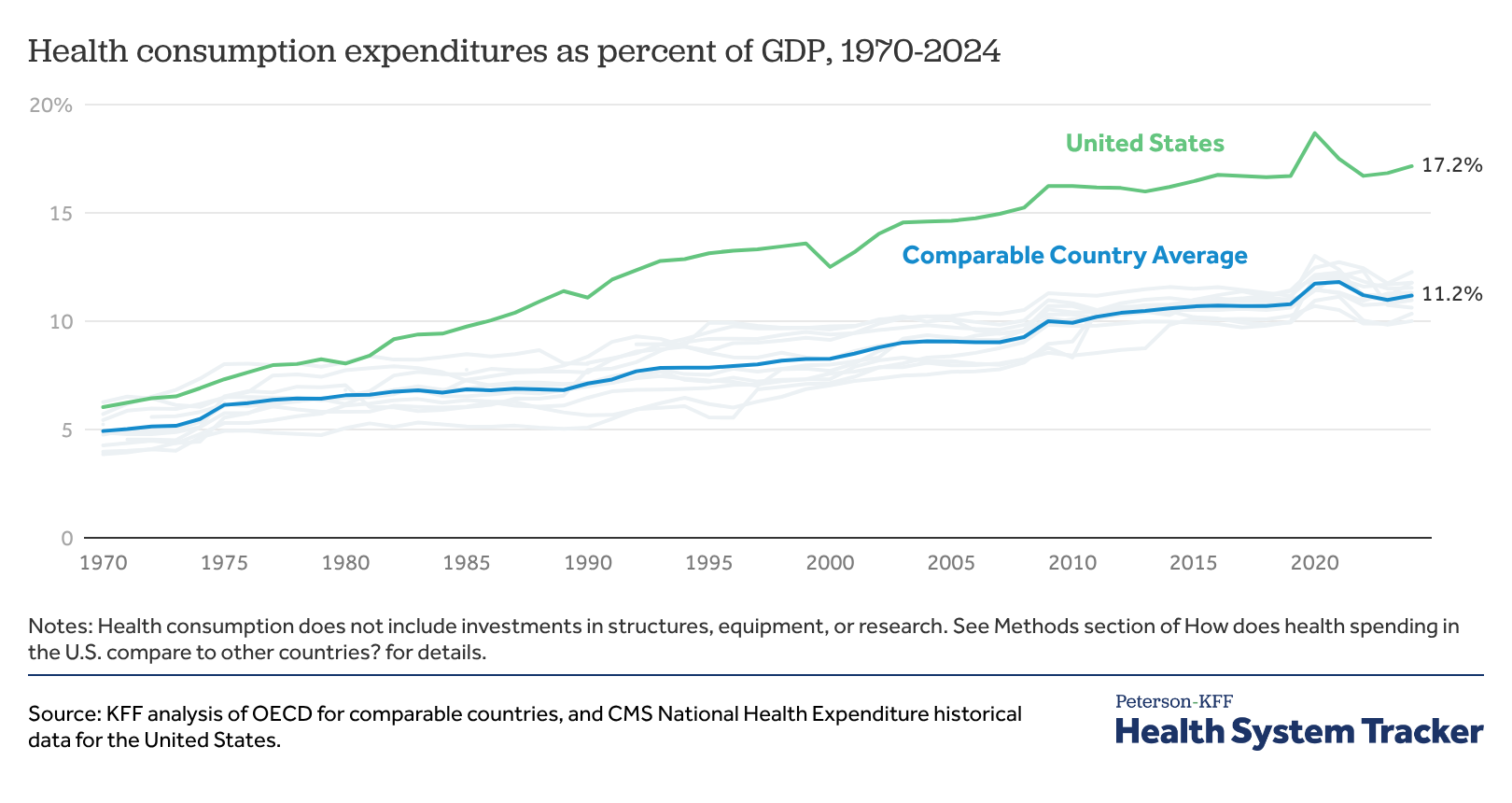
In this case the only thing measured is
spending. Outcomes, quality, whatever aren't mentioned. This is pretty much irrelevant.