Clinton says being a capitalist likely hurt her among socialist Dems

Hillary Clinton agreed Wednesday that being a capitalist likely damaged her 2016 campaign because nearly half of Democrats say they are socialists.

"Probably," Clinton said at the Shared Values Leadership Summit in New York City, after being asked whether support for capitalism hurt her at the polls.

"It's hard to know, but if you're in the Iowa caucuses and 41 percent of Democrats are socialists, or self-described socialists, and I'm asked, ‘Are you a capitalist?' And I say, ‘Yes, but with appropriate regulation and appropriate accountability,' you know, that probably gets lost in the ‘Oh my gosh, she's a capitalist.'"

The former U.S. secretary of state was challenged from the left during the Democratic primaries by self-described democratic socialist Bernie Sanders, the U.S. senator from Vermont who repeatedly criticized her for being bankrolled by Wall Street and not going after capitalism and with the same hostility as the Democratic grassroots hoped for.

During the first Democratic debate in 2015, Sanders refused to identify himself as a capitalist.

“Do I consider myself part of the casino capitalist process by which so few have so much and so many have so little?” he asked. “By which Wall Street greed and recklessness wrecked this economy? No I don’t.”

Clinton, meanwhile, offered a defense of capitalism, saying: “When I think about capitalism, I think about all the businesses that were started because we have the opportunity and the freedom to do that and to make a good living for themselves and their families … We would be making a grave mistake to turn our backs on what built the greatest middle class in the history.”
http://www.foxnews.com/politics/201...ist-likely-hurt-her-among-socialist-dems.html

What irony. Would it occur to her swelled head that if half the Dems are socialists, that a good number of the Dems who are NOT, voted for Trump?
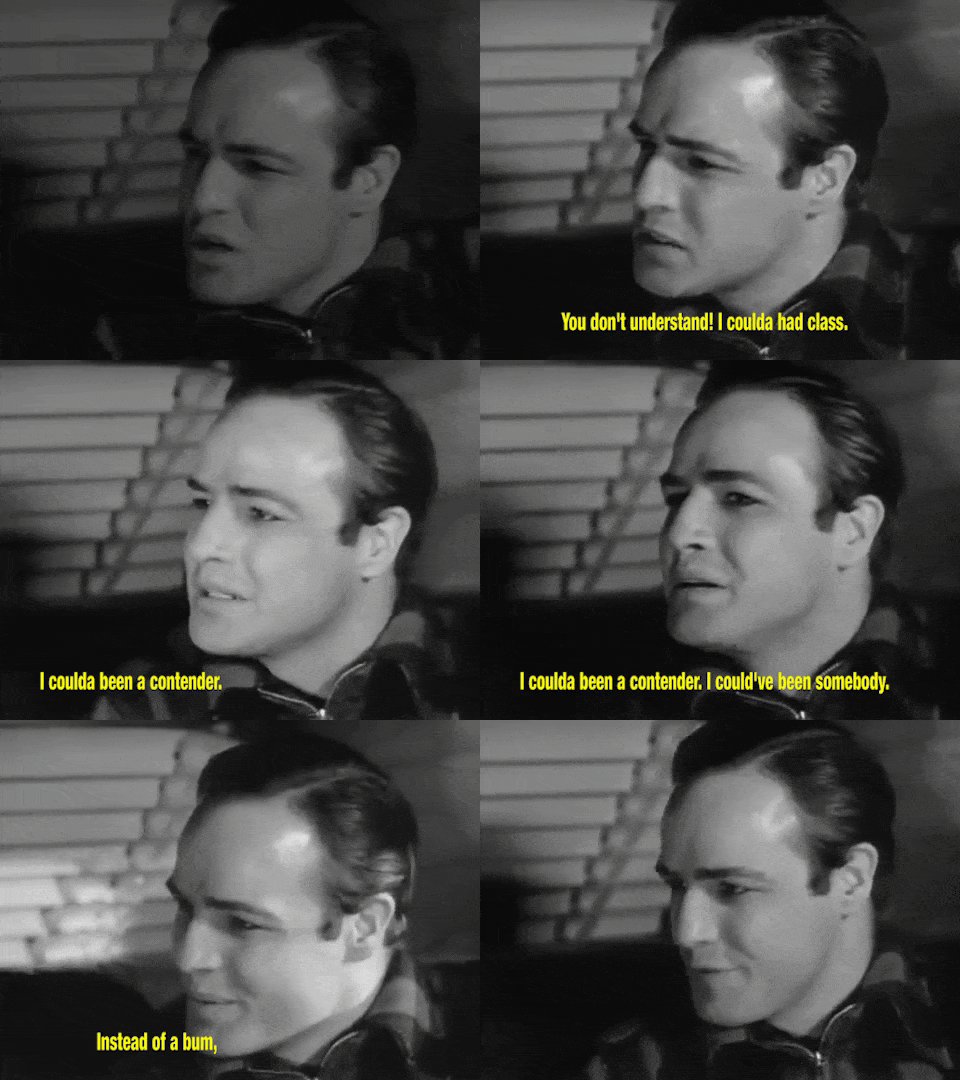
Dear Hillary, you weren't able to convince enough capitalists that you were one of them. You shoulda been prez, you coulda been prez, but you just don't understand why the deplorables didn't feel the love.

giphy-downsized-large.gif
 
Shattered: Inside Hillary Clinton's Doomed Campaign is a book by political journalists Jonathan Allen and Amie Parnes about Hillary Clinton's unsuccessful 2016 presidential campaign.

Here's a brief review from Rolling Stone................

Yikes! New Behind-the-Scenes Book Brutalizes the Clinton Campaign

'Shattered,' a campaign tell-all fueled by anonymous sources, outlines a generational political disaster


By Matt Taibbi
April 20, 2017

There is a critical scene in Shattered, the new behind-the-scenes campaign diary by Jonathan Allen and Amie Parnes, in which staffers in the Hillary Clinton campaign begin to bicker with one another.

At the end of Chapter One, which is entirely about that campaign's exhausting and fruitless search for a plausible explanation for why Hillary was running, writers Allen and Parnes talk about the infighting problem.

"All of the jockeying might have been all right, but for a root problem that confounded everyone on the campaign and outside it," they wrote. "Hillary had been running for president for almost a decade and still didn't really have a rationale."

Allen and Parnes here quoted a Clinton aide who jokingly summed up Clinton's real motivation:

"I would have had a reason for running," one of her top aides said, "or I wouldn't have run."

The beleaguered Clinton staff spent the better part of two years trying to roll this insane tautology – "I have a reason for running because no one runs without a reason" – into the White House. It was a Beltway take on the classic Descartes formulation: "I seek re-election, therefore I am... seeking re-election."

Shattered is sourced almost entirely to figures inside the Clinton campaign who were and are deeply loyal to Clinton. Yet those sources tell of a campaign that spent nearly two years paralyzed by simple existential questions: Why are we running? What do we stand for?

If you're wondering what might be the point of rehashing this now, the responsibility for opposing Donald Trump going forward still rests with the (mostly anonymous) voices described in this book.

What Allen and Parnes captured in Shattered was a far more revealing portrait of the Democratic Party intelligentsia than, say, the WikiLeaks dumps. And while the book is profoundly unflattering to Hillary Clinton, the problem it describes really has nothing to do with Secretary Clinton.

The real protagonist of this book is a Washington political establishment that has lost the ability to explain itself or its motives to people outside the Beltway.

In fact, it shines through in the book that the voters' need to understand why this or that person is running for office is viewed in Washington as little more than an annoying problem.

In the Clinton run, that problem became such a millstone around the neck of the campaign that staffers began to flirt with the idea of sharing the uninspiring truth with voters. Stumped for months by how to explain why their candidate wanted to be president, Clinton staffers began toying with the idea of seeing how "Because it's her turn" might fly as a public rallying cry.

This passage describes the mood inside the campaign early in the Iowa race (emphasis mine):

"There wasn't a real clear sense of why she was in it. Minus that, people want to assign their own motivations – at the very best, a politician who thinks it's her turn," one campaign staffer said. "It was true and earnest, but also received well. We were talking to Democrats, who largely didn't think she was evil."

Our own voters "largely" don't think your real reason for running for president is evil qualified as good news in this book. The book is filled with similar scenes of brutal unintentional comedy.

In May of 2015, as Hillary was planning her first major TV interview – an address the campaign hoped would put to rest criticism Hillary was avoiding the press over the burgeoning email scandal – communications chief Jennifer Palmieri asked Huma Abedin to ask Hillary who she wanted to conduct the interview. (There are a lot of these games of "telephone" in the book, as only a tiny group of people had access to the increasingly secretive candidate.)

The answer that came back was that Hillary wanted to do the interview with "Brianna." Palmieri took this to mean CNN's Brianna Keilar, and worked to set up the interview, which aired on July 7th of that year.

Unfortunately, Keilar was not particularly gentle in her conduct of the interview. Among other things, she asked Hillary questions like, "Would you vote for someone you didn't trust?" An aide describes Hillary as "staring daggers" at Keilar. Internally, the interview was viewed as a disaster.

It turns out now it was all a mistake. Hillary had not wanted Brianna Keilar as an interviewer, but Bianna Golodryga of Yahoo! News, an excellent interviewer in her own right, but also one who happens to be the spouse of longtime Clinton administration aide Peter Orszag.

This "I said lunch, not launch!" slapstick mishap underscored for the Clinton campaign the hazards of venturing one millimeter outside the circle of trust. In one early conference call with speechwriters, Clinton sounded reserved:

"Though she was speaking with a small group made up mostly of intimates, she sounded like she was addressing a roomful of supporters – inhibited by the concern that whatever she said might be leaked to the press."

This traced back to 2008, a failed run that the Clintons had concluded was due to the disloyalty and treachery of staff and other Democrats. After that race, Hillary had aides create "loyalty scores" (from one for most loyal, to seven for most treacherous) for members of Congress. Bill Clinton since 2008 had "campaigned against some of the sevens" to "help knock them out of office," apparently to purify the Dem ranks heading into 2016.

Beyond that, Hillary after 2008 conducted a unique autopsy of her failed campaign. This reportedly included personally going back and reading through the email messages of her staffers:

"She instructed a trusted aide to access the campaign's server and download the messages sent and received by top staffers. … She believed her campaign had failed her – not the other way around – and she wanted 'to see who was talking to who, who was leaking to who,' said a source familiar with the operation."

Some will say this Nixonesque prying into her staff's communications will make complaints about leaked emails ring a little hollow.

Who knows about that. Reading your employees' emails isn't nearly the same as having an outsider leak them all over the world. Still, such a criticism would miss the point, which is that Hillary was looking in the wrong place for a reason for her 2008 loss. That she was convinced her staff was at fault makes sense, as Washington politicians tend to view everything through an insider lens.

Most don't see elections as organic movements within populations of millions, but as dueling contests of "whip-smart" organizers who know how to get the cattle to vote the right way. If someone wins an election, the inevitable Beltway conclusion is that the winner had better puppeteers.

The Clinton campaign in 2016, for instance, never saw the Bernie Sanders campaign as being driven by millions of people who over the course of decades had become dissatisfied with the party. They instead saw one cheap stunt pulled by an illegitimate back-bencher, foolishness that would be ended if Sanders himself could somehow be removed.

"Bill and Hillary had wanted to put [Sanders] down like a junkyard dog early on," Allen and Parnes wrote. The only reason they didn't, they explained, was an irritating chance problem: Sanders "was liked," which meant going negative would backfire.

Hillary had had the same problem with Barack Obama, with whom she and her husband had elected to go heavily negative in 2008, only to see that strategy go very wrong. "It boomeranged," as it's put in Shattered.

The Clinton campaign was convinced that Obama won in 2008 not because he was a better candidate, or buoyed by an electorate that was disgusted with the Iraq War. Obama won, they believed, because he had a better campaign operation – i.e., better Washingtonian puppeteers. In The Right Stuff terms, Obama's Germans were better than Hillary's Germans.

They were determined not to make the same mistake in 2016. Here, the thought process of campaign chief Robby Mook is described:

"Mook knew that Hillary viewed almost every early decision through a 2008 lens: she thought almost everything her own campaign had done was flawed and everything Obama's had done was pristine."

Since Obama had spent efficiently and Hillary in 2008 had not, this led to spending cutbacks in the 2016 race in crucial areas, including the hiring of outreach staff in states like Michigan. This led to a string of similarly insane self-defeating decisions. As the book puts it, the "obsession with efficiency had come at the cost of broad voter contact in states that would become important battlegrounds."

If the ending to this story were anything other than Donald Trump being elected president, Shattered would be an awesome comedy, like a Kafka novel – a lunatic bureaucracy devouring itself. But since the ending is the opposite of funny, it will likely be consumed as a cautionary tale.

Shattered is what happens when political parties become too disconnected from their voters. Even if you think the election was stolen, any Democrat who reads this book will come away believing he or she belongs to a party stuck in a profound identity crisis. Trump or no Trump, the Democrats need therapy – and soon.
 
How Team Hillary played the press for fools on Russia

Hillary Clinton’s campaign didn’t just pay for the Kremlin-aided smear job on Donald Trump before the election; she continued to use the dirt after the election to frame her humiliating loss as a Russian conspiracy to steal the election.

Bitter to the core, she and her campaign aides hatched a scheme, just 24 hours after conceding the race, to spoon-feed the dirty rumors to an eager liberal media and manufacture the narrative that Russia secretly colluded with her neophyte foe to sabotage her coronation.

But it was Hillary who was trying to kneecap Trump, even after he licked her, fair and square, in Wisconsin, Pennsylvania, Michigan and other blue states.

Exhibit A is the book “Shattered: Inside Hillary Clinton’s Doomed Campaign,” by Jonathan Allen and Amie Parnes. In light of this week’s revelation that Hillary’s campaign funded the dirty anti-Trump “Steele” dossier, the book takes on a new significance. It reveals:

“Within 24 hours of her concession speech, [campaign chair John Podesta and manager Robby Mook] assembled her communications team at the Brooklyn headquarters to engineer the case that the election wasn’t entirely on the up-and-up. For a couple of hours, with Shake Shack containers littering the room, they went over the script they would pitch to the press and the public. Already, Russian hacking was the centerpiece of the argument.”

The plan, according to the book, was to push journalists to cover how “Russian hacking was the major unreported story of the campaign,” and it succeeded to a fare-thee-well. After the election, coverage of the Russian “collusion” story was relentless, and it helped pressure investigations and hearings on Capitol Hill and even the naming of a special counsel, which in turn has triggered virtually nonstop coverage.

A new Media Research Center study finds that, since the inauguration, major TV news networks have devoted an astonishing 1,000 minutes out of a total 5,015 minutes of Trump administration coverage discussing speculation that the Trump campaign may have colluded with Moscow in hacking Clinton campaign emails, “which means the Russia story alone has comprised almost one-fifth of all Trump news this year.” In contrast, they so far have devoted just 20 seconds to the more substantive scandal of Hillary and her husband possibly trading US uranium rights for Russian cash.

MRC analysts also found that more than a third of the networks’ Russia “scandal” coverage was based on anonymous sources who worked in the Obama administration, including Hillary’s State Department.

Though some of that coverage has proved erroneous, leading to retracted stories and fired reporters, the damage is done. Trump’s approval ratings have suffered, and the Russia investigation has distracted the administration.

Which was also part of Hillary’s plan.

In March, former Clinton campaign communications director Jennifer Palmieri summed up the post-election strategy in a Washington Post column comparing “Russiagate” to Watergate and encouraging the press and other Democrats to “turn the Russia story against Trump.”

“If we make plain that what Russia has done is nothing less than an attack on our republic, the public will be with us. And the more we talk about it, the more they’ll be with us,” she advised. “Polls show that voters are now concerned about the Russia story and overwhelmingly support an independent investigation.”

In short, Hillary couldn’t beat Trump with the political dirt she secretly purchased during the campaign, so she tried to cripple his presidency with help from an overwhelmingly anti-Trump media. Framing Trump as some sort of modern-day KGB plant was an easy sell, since the pro-Democrat media were also searching for a scapegoat to rationalize the crushing defeat of their shared liberal agenda at the polls.

The irony is, it may have in fact been Hillary who came closer to colluding with the Russians in smearing Trump as a Russian traitor than anything Trump did in trying to beat Hillary. The information in the dossier she bought for millions came from Russian intelligence sources, and her lawyers brokered the deal with a Kremlin-tied lobbyist. When it failed to stop Trump, the Russia paymaster turned into the Russia spinmeister.

Now we really know “What Happened.”


https://nypost.com/2017/10/26/how-team-hillary-played-the-press-for-fools-on-russia/
 
I read Shattered and Chasing Hillary. Very similar but Chasing Hillary by Amy Chozick was more entertaining, downright funny in parts.
Amy Chozick also wrote the same thing... that even hrc could never convey why she was running. Except we all know that it was just blind ambition.
The other thing Chozick wrote is that after covering hrc for more than a decade she never could figure out what she stood for and still doesn't know after the election.
Well I think I can explain that. What hrc stands for is using politics as a vehicle for making money. No real principles. Campaigns against Wall St., gives speeches to Wall St. execs (for gobs of money) saying she just has to do that, don't worry she has their back.
Campaigns against war yet a real pro war neo-con.
Panders to blacks with a fake Aunt Jemima dialect, yet calls young black males super predators that need to be heeled, then it was a "misstatement", no apology.
Chozick gives many examples of hrc's contradictions.
I highly recommend the book, but you can skip at least the first 1/4 of it.
 
Chasing Hillary by Amy Chozick was more entertaining, downright funny in parts.

Campaigns against war yet a real pro war neo-con....

I highly recommend the book...
Sounds like Hillary chases herself by blind ambition with rudderless abandon in her quest for power
 
Republicans won congress back with tea party support in large part because government spent too much. Are those same congressmen now supposed to say it's ok to spend because Trump is in office?

You have a point.

But you also prove my point: Obama never had to contend with a Never Obama wing in his own party. It was the exact opposite—Democrats in Congress couldn’t line up behind him fast enough, in fact. They passed Obamacare without a single republican vote.

It’s pretty remarkable what this president has accomplished in spite of having an SC tied around his neck, an historically hostile media and having to fight an element within his own party.
 
So Social Security and unemployment insurance do not mitigate poverty? you are always so wrong. We could raise them a bunch and get even more payback for our tax money.

Affirmative action was about leveling the playing field since so many bigots, like you, stepped in front of blacks getting fair opportunities. It actually works.

It's not the government's job to mitigate poverty. It your job to do better for yourself so the rest of us aren't forced to support your sorry ass.

Typical blame the other guy when the content of your character doesn't match up to others. Nothing but excuses for people who couldn't otherwise get a job based on their qualifications. If you have to use affirmative action, you're not worth hiring.
 
Republicans won congress back with tea party support in large part because government spent too much. Are those same congressmen now supposed to say it's ok to spend because Trump is in office?
most of the never-trumpers were old school GOP like the Bushes and that Ohio governor who's name I forget........not the tea partiers.......
 
and that's not even in the best interests of the nation.......

The bleeding heart Liberal mentality never has been.

My understand of what the founding fathers meant by general welfare was that the government's role in society was to create an environment where people, by using their skills, desires, and abilities, would better themselves or fail if they refused to try. People like Nordberg have twisted it to mean it's the government's responsibility to take care of you when you fail by taking from those that bettered themselves.

If the founding fathers had intended for general welfare to mean social welfare, why wouldn't they have made more specific mention of those types of things?
 
Sounds like Hillary chases herself by blind ambition with rudderless abandon in her quest for power

And, that's her great weakness. No appealing message to the middle America masses and plan with points of accomplishments that she'd be able to check off once in office. Her quest for power is for herself, not for America's citizens.
 
And, that's her great weakness. No appealing message to the middle America masses and plan with points of accomplishments that she'd be able to check off once in office. Her quest for power is for herself, not for America's citizens.
yeppers.. what was the campaign message? *crickets*. "It's my turn"
 
Back
Top