Strange: Pope Leo Silent on These Deaths

Knuckles

Verified User
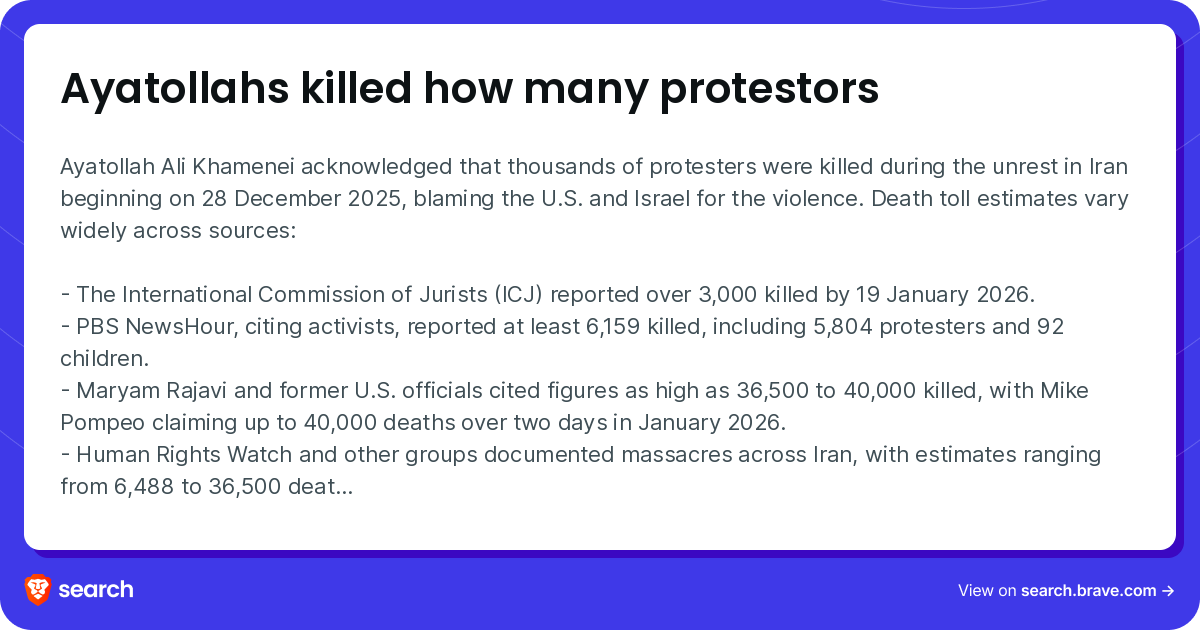
Ayatollah Ali Khamenei, Iran's Supreme Leader, ordered security forces to execute thousands of protesters during the 2026 uprising, with official figures ranging from 3,117 to over 36,500 deaths depending on the source.

  • Official Iranian Government figures (reported by the Martyrs Foundation) state that 3,117 people were killed, a number that includes security forces killed by protesters.
  • Independent and international estimates place the death toll significantly higher, with reports citing over 30,000 protesters killed between late December 2025 and February 2026.
  • HRANA, a human rights group, confirmed 6,488 protester deaths (including 236 minors) as of late January 2026, with thousands more under investigation.
  • President Donald Trump cited an estimate of over 32,000 protesters killed in a February 2026 press briefing.
  • Khamenei acknowledged in January 2026 that "thousands" had been killed but blamed the United States and President Trump for the unrest.
The discrepancy in numbers is attributed to internet blackouts, restricted access for journalists, and the Iranian government's control over information regarding the crackdown.
Brave AI
 
Last edited:
Pope Silent on Iran Protests

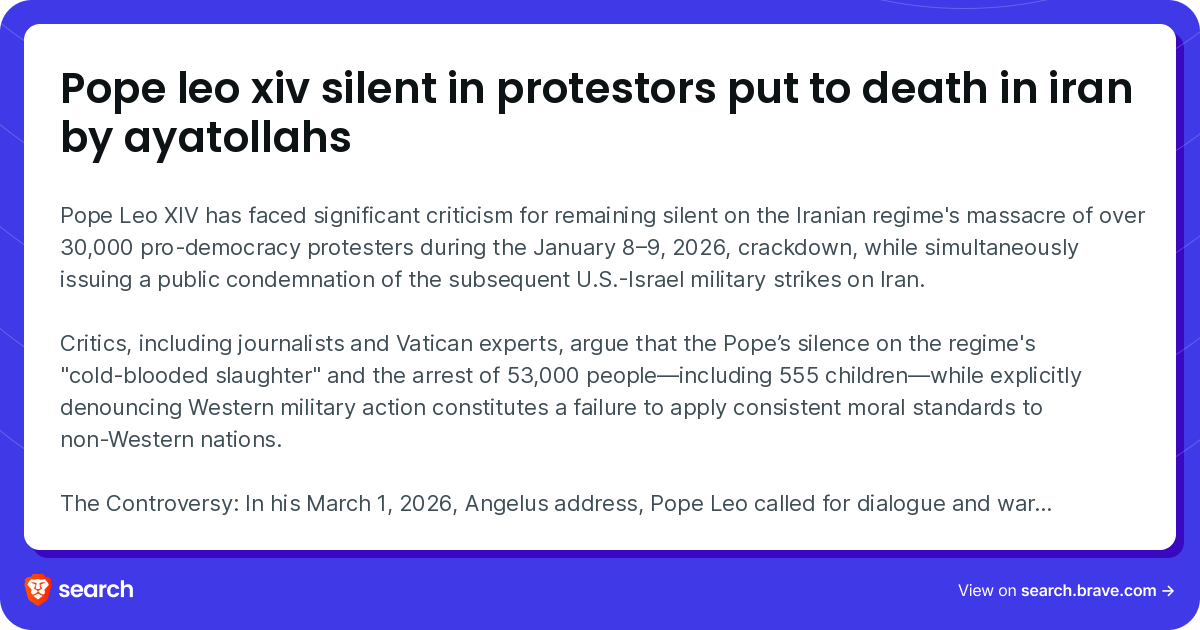
Pope Leo XIV has faced **significant criticism for remaining silent** on the Iranian regime's massacre of over **30,000 pro-democracy protesters** during the January 8–9, 2026, crackdown, while simultaneously issuing a public condemnation of the subsequent U.S.-Israel military strikes on Iran.

Critics, including journalists and Vatican experts, argue that the Pope’s silence on the regime's **"cold-blooded slaughter"** and the arrest of 53,000 people—including 555 children—while explicitly denouncing Western military action constitutes a failure to apply consistent moral standards to non-Western nations.

* **The Controversy**: In his March 1, 2026, Angelus address, Pope Leo called for dialogue and warned against the "spiral of violence" caused by the U.S.-Israel strikes but made **no direct reference** to the Iranian government's internal repression or the killing of demonstrators.
* **The Criticism**: Commentators noted that the Pope **rejected an appeal** from exiled Crown Prince Reza Pahlavi to speak up for persecuted Christians and ignored reports of 1.2 million converts facing severe imprisonment and internal exile.
* **The Context**: While the Vatican's Secretary of State, Cardinal Pietro Parolin, made an informal comment questioning how a government could "attack its own people," the Pope himself maintained a cautious diplomatic line, prioritizing the resumption of peace talks over condemning the Ayatollahs' actions.
 
Pope Silent on Iran Protests

Pope Leo XIV has faced **significant criticism for remaining silent** on the Iranian regime's massacre of over **30,000 pro-democracy protesters** during the January 8–9, 2026, crackdown, while simultaneously issuing a public condemnation of the subsequent U.S.-Israel military strikes on Iran.

Critics, including journalists and Vatican experts, argue that the Pope’s silence on the regime's **"cold-blooded slaughter"** and the arrest of 53,000 people—including 555 children—while explicitly denouncing Western military action constitutes a failure to apply consistent moral standards to non-Western nations.
What it constitutes is the Pope's recognition of where he has moral authority and where he doesn't.
 
What it constitutes is the Pope's recognition of where he has moral authority and where he doesn't.
A shepherd who finds his voice for foreign airstrikes but not for butchered protesters is not showing prudence. He is showing partiality. Moral witness is not a sacrament you administer only to the West.

The Pope’s moral authority, if it means anything (and it does not to me) , is the authority to make moral judgments about human conduct: war, repression, murder, persecution, injustice. That applies to both a state bombing another state and a regime massacring its own civilians. You do not get one category from God and not the other.
 
What it constitutes is the Pope's recognition of where he has moral authority and where he doesn't.
One gets executed tomorrow, and it's their policy to rape her first, so she doesn't go to paradise.
They do it to all men they execute, too.
 
Last edited:
A shepherd who finds his voice for foreign airstrikes but not for butchered protesters is not showing prudence. He is showing partiality. Moral witness is not a sacrament you administer only to the West.

The Pope’s moral authority, if it means anything (and it does not to me) , is the authority to make moral judgments about human conduct: war, repression, murder, persecution, injustice. That applies to both a state bombing another state and a regime massacring its own civilians. You do not get one category from God and not the other.
Too bad you're a halfwit. Not a matter of making a moral judgment, but declaring one to those who reject your authority to do so. The Pope seems to have decided to limit his comments to sinful conduct by Christians.
 
Last edited:
Too bad you're a halfwit. Not a matter of making a moral judgment, but declaring one to those who reject your authority to do so. The Pope seems to have decided to limit his comments on sinful conduct by Christians to Christians.
That is even dumber. Moral authority is not measured by whether the guilty party accepts it. By that logic, no prophet, pope, preacher, judge, or dissident could ever condemn evil unless the evildoer first agreed to be judged.
 
The sun is up, the sky is blue,
the dead are real, so where were you?
Dear Prudence, won’t you come out to say......


Prudence is not infallibility. It is a practical judgment about how to apply moral truth in the real world. So if a pope condemns one form of bloodshed while staying muted about another, people are fully entitled to question whether that was prudent, consistent, or courageous. That is not rejecting his office. It is evaluating his use of it.
 
And? What does that have to do with politics?
It has to do with politics because power and influence are political even when they are not democratic. And your standard is hypocritical: Christianity was not built by referendum, and the canon was not delivered by popular vote either. So “unelected” clearly does not mean “irrelevant” in your own tradition. The pope is politically relevant because he influences millions of people and states treat him as a serious moral and diplomatic actor.
 
It has to do with politics because power and influence are political even when they are not democratic. And your standard is hypocritical: Christianity was not built by referendum, and the canon was not delivered by popular vote either. So “unelected” clearly does not mean “irrelevant” in your own tradition. The pope is politically relevant because he influences millions of people and states treat him as a serious moral and diplomatic actor.
And religion is supposed to remain a political The Pope should focus on the gospel of Jesus Christ
 
And religion is supposed to remain a political The Pope should focus on the gospel of Jesus Christ
Christianity has never been “just private spirituality.” The Gospel makes moral claims about justice, power, rulers, violence, truth, wealth, hypocrisy, and the treatment of the weak. Once a religious leader speaks on those things, he is operating in the moral space that overlaps with politics.
 
I'll never understand why we put any political value in a man elected by 105 un-elected cardinals.
I'll never understand why magats talk about all the Iranians killed by their leaders, as if that was justification to start a war, but have always ignored the ongoing genocide in Darfur.

The Pope is an American citizen and has the same right as you to speak out against trump's unspeakable war. And what's it to you how Catholics elect the leader of their church?
 
That is even dumber. Moral authority is not measured by whether the guilty party accepts it. By that logic, no prophet, pope, preacher, judge, or dissident could ever condemn evil unless the evildoer first agreed to be judged.
Who said it was? The point is that cowardly Trump supporters rather than "accepting" the Pope's criticism are attempting to turn the the criticism back on him as if his inconsistency, so claimed, lets them off the moral hook.
 
And religion is supposed to remain a political The Pope should focus on the gospel of Jesus Christ
Tell that to trump's so-called religious advisor, Paula Cain. Not to mention all the other religious leaders who've spoken out either for or against the war.

"As Americans woke up to the news on Saturday morning that the U.S. government had launched large-scale attacks against Iran, those on X awoke to the predictable sound of evangelical leaders racing to fawn over the actions of the man for whom they have compromised their witness, Donald Trump."

 
Who said it was? The point is that cowardly Trump supporters rather than "accepting" the Pope's criticism are attempting to turn the the criticism back on him as if his inconsistency, so claimed, lets them off the moral hook.
You did, implicitly. Your whole line of argument treated the fact that Trump supporters reject the pope’s criticism, or throw criticism back at him, as though that somehow diminishes the pope’s moral standing to judge them. That only makes sense if you are smuggling in the idea that moral authority depends on being accepted by the people condemned.

and You are changing the subject. The question was never whether criticism disappears if the guilty party refuses it. Of course it does not. The question is whether a self-styled moral authority can be criticized for selective indignation and inconsistency.
 
Back
Top