The world is thirsty for oil. Can America replace the oil that Trump has bottled up?

Mahmoud Ahmadinejad

سپاه پاسداران انقلاب اسلامی
HF9pKB2bEAMMCuD


Not quickly.

Not easily.

Not inexpensively.

It is true, as Trump boasted, that an unusually large number of oil tankers have been booked to load U.S. crude oil since America forcibly seized control of the world's primary oil shipping route.

Despite his ill-informed braggadocio, the US is not equipped to process the scores of VLCC (very large crude carriers) headed toward America. The backlog will take months to clear.

The logistical challenges of loading empty supertankers with oil include increased operational costs due to longer empty voyages and capacity constraints that force the use of smaller vessels or multiple shipments.

Trump's simple-minded supporters with no knowledge of the challenges of transhipping petroleum and LNG (liquid natural gas) clap like seals, anticipating an economic bonanza from Trump's pritatical activities in the Persian Gulf.

They are doomed to disappointment.

Filling a 2 million gallon supertanker, (let alone dozens of them) is not as easy as gassing up a pickup at the local convenience store.

Each VLCC can carry roughly 2 million barrels of oil, so the group represents massive potential export volume (over 120 million barrels from the VLCCs alone).

The influx stems from a sharp disruption in Persian Gulf oil flows (exports through the Strait of Hormuz aredown ~92%, from 20 million to just 1.5 million barrels per day due to the American blockade).

Trump and others may view this “swarm” as a huge boon; proof of surging global demand for American oil, an export windfall, and a geopolitical win for U.S. energy dominance.

However, the facts (backed by current EIA export data, port logistics, and global inventory trends) is that it is not the straightforward economic victory it may appear to be.

Here are the main reasons:

1. U.S. export infrastructure cannot handle the volume quickly
  • Current U.S. crude export rate (as of January 2026 data cited): ~3.9 million barrels per day.
  • Practical maximum capacity: around 4–5 million barrels per day.
  • Loading even the 60+ VLCCs alone would require moving ~120 million barrels. At realistic Gulf Coast throughput rates, this creates severe bottlenecks at key terminals (e.g., Houston, Galveston, Louisiana Offshore Oil Port/LOOP).
  • Result: Tankers will face long waiting times, congestion, and delays. This is not a simple “turn on the tap” scenario. Ports and loading infrastructure have physical and operational limits that cannot scale instantly.
2. It will trigger (or exacerbate) a global oil supply shock and higher prices
  • The tankers are rushing to the U.S. precisely because Persian Gulf supply has collapsed. Global oil inventories are already drawing down sharply (218 million barrels in recent data, with an even steeper drop projected for 2026).
  • U.S. exports cannot ramp up fast enough to replace the lost Middle East barrels. Even major Saudi loading ports like Yanbu are capped at ~4.5 million barrels per day—far short of what the redirected tanker fleet needs.
  • Outcome: Worldwide crude shortages → spiking oil prices. Because oil is a global commodity, U.S. consumers will still see higher gasoline, diesel, and heating-fuel costs, offsetting any domestic producer gains.
3. U.S. refineries and the domestic market are not optimized for this scenario
  • Many U.S. refineries are configured to process heavier imported crudes; domestic shale/fracking output is lighter and requires blending or export. The sudden export surge strains this balance.
  • The U.S. is already drawing from the Strategic Petroleum Reserve (SPR) to cushion shortages. This depletes emergency stocks rather than building energy security.
4. Short-term gains for oil companies vs. broader economic pain
  • Oil producers and exporters may enjoy higher prices and strong demand in the near term.
  • But the video emphasizes the longer-term downsides: global economic ripple effects, higher fuel costs for American households and industries, supply-chain disruptions, and the risk that prolonged Persian Gulf bottlenecks keeps the tanker swarm (and price volatility) going indefinitely.
In short, the tanker swarm is a symptom of a broken global supply chain rather than a triumphant “America-first” energy moment.

The U.S. simply lacks the immediate export infrastructure and spare capacity to turn the situation into the rapid, low-pain boom some political rhetoric suggests.

Instead, Trump's boasting obscures the fact that his cowardly bullying risks higher domestic fuel prices, logistical gridlock, and accelerated SPR drawdowns, exactly the opposite of a win.
 
Boastful bully Trump recently posted a satellite image of 68 supertankers assembled in the Gulf of Mexico, bound for American ports to load crude oil.

Behind the image lay a claim that had been building for weeks: the United States is the world's largest producer, and whatever the Strait of Hormuz removes from global circulation, American wells can replace.

The production number is accurate.

Every conclusion drawn from it is not.

The United States imports 6.2 million barrels per day of crude while exporting 4.9 million; America is a structural net importer of the commodity it produces in record volume.

The water's edge is where Trump's boast dies.

“GREAT!!!” read the caption. Behind the image lay an argument that had been building for weeks across cable television and social media: the United States is the world’s largest crude producer, at 13.6 million barrels per day, and whatever the Strait of Hormuz — the 21-mile chokepoint between Iran and Oman through which approximately 20 million barrels per day of oil and petroleum products transit — removes from global circulation, American wells and terminals can replace. The argument is wrong: not at the level of the production number, which is accurate, but at every step between the wellhead and the water’s edge.

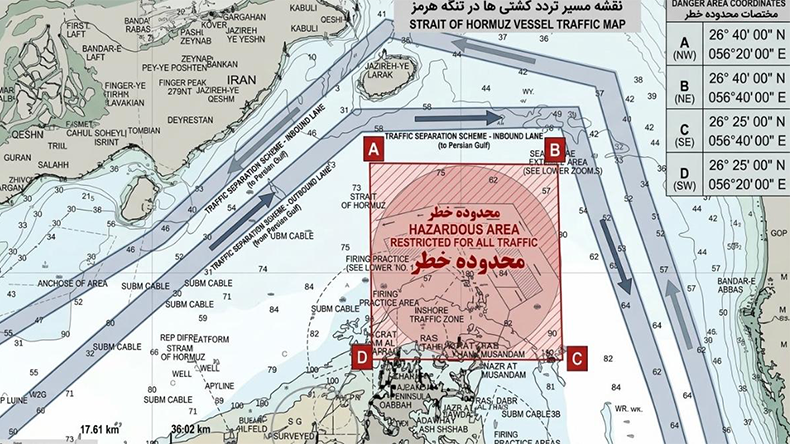
The Strait of Hormuz was effectively closed in early March 2026 following the outbreak of US-Israeli air operations against Iran.

On April 12, after Iran’s refusal to surrender, the nraged tyrant Trump effectively closed the Strait by announcing a US Navy blockade. He gave orders to intercept any vessel that had paid Iran’s $2 million transit fee.

Now Trump has bottled up Iraq, Saudi Arabia, Kuwait, the United Arab Emirates, Qatar, and Bahrain. These oil producers have together lost approximately 9.1 million barrels per day of production, according to the EIA’s April 2026 Short-Term Energy Outlook.

The question is not whether he United States can make up the shortfall. It cannot.

Not in any timeframe measured in months, or even years.

Trump's idle boasting rests on four conflations that do not match the limits of the physical infrastructure: US production volume against net exportable crude surplus; the country’s net crude position against its net total petroleum position; total commercial petroleum stocks against genuinely exportable crude above minimum operating levels; and the Strategic Petroleum Reserve against a freely deployable export buffer.

Strip away each conflation, and the United States has approximately 1 million barrels per day of redirectable spot crude. That's only eleven percent of the gap, available for new buyers, deliverable late, insured at 25 times the pre-war rate, routed 30 days the long way around Africa.

The water’s edge is where the Trump's daydream dies.

The world’s largest crude producer imports 6.2 million barrels per day of crude oil and exports 4.9 million.

These facts are not contradictory. They describe a refinery system built before the shale era for a grade of crude the Permian Basin does not produce.

The United States is simultaneously the world’s largest crude producer and a structural net importer of crude oil, and the distinction matters more right now than at any point since the 1970s.

Not only is Trump's reckless act starving his purported allies in the Middle East, Europe, and Asia of a precious commodity and wrecking their economies, he is making everything Americans buy (or produce) more expensive.

He's a failure.
 
Do any of you armchair energy experts know which Pacific Rim refineries are gearing up to take lighter US crudes from Corpus Christi, Houston/Galveston and the LOOP with their Persian Gulf supply currently choked off by tyrant Trump?

He's a failure.
 
American refineries consume approximately 20.4 million barrels per day of total petroleum.

If you were to compare that against 13.6 million barrels per day of domestic crude production, the structural deficit is approximately 6.9 million barrels per day.

That is normally filled by imports. The United States is a net crude importer by approximately 2.2 million barrels per day. This is not a paradox; it is the arithmetic of refinery systems.

The mechanism is grade. US shale production is overwhelmingly light sweet crude. That is low-sulfur, high-API-gravity oil (American Petroleum Institute/API gravity is a measure of how heavy or light petroleum liquids are compared to water, expressed in degrees).

American oil commands a premium in specialist markets but cannot efficiently run the coking and hydrocracking units that dominate Gulf Coast refinery capacity.

Those units were built between the 1940s and 1980s, when Middle Eastern heavy crude was the world’s dominant feedstock.

Saudi Arab Light (API gravity 33, sulfur content 1.8%) and Arab Heavy (API gravity 28, sulfur 2.8%) are the grades those units were designed for.

The Permian Basin’s WTI-grade crude (API gravity above 40, sulfur below 0.5%) cannot run them efficiently.

So the United States exports the light crude its refineries do not need and imports the heavy sour crude they require. Thanks to Trump's arrogance and ignorance, you are "cooked", as they say.

Two numbers capture the precariousness of America's petroleum position precisely.

The 2.8 million barrels per day “net exporter” figure that circulates in Fox News commentary, often cited by Trump's Energy Secretary and repeated on social media by the ignorant, (and fact-checked “Half True” by WRAL in March 2026) is the net total petroleum surplus: it counts crude oil, refined products (gasoline, diesel, jet fuel), natural gas plant liquids, and all other petroleum-derived commodities. It is technically accurate for total petroleum, but there is a catch for the simplistic Americans who support the tyrant Trump:

  • For crude oil alone, (the only commodity that can fill a foreign refiner's crude slate) the United States is a net importer by approximately 2.2 million barrels per day.
  • Refined products cannot substitute as crude. They cannot be sent to Asian or European refineries and processed into the fuel those economies need.
Trump is a failure.
 
It appears that none of the blusterers have anything to say about the way their Commander-in-Chief has condemned them to pay more for the products they consume. The products America produces are also becoming more costly. Oil is the key; you bought the boast, but you didn't know that there's more to it than that.

Tyrant Trump has well and truly sold you a pig in a poke. It would be funny if his military wasn't killing people.

Allow me to tell you more.

Total US commercial petroleum stocks stood at approximately 850 million barrels as of the week ending April 3, 2026, according to the EIA’s Weekly Petroleum Status Report.

The figure circulates widely.

Its composition does not: approximately 240 million barrels is gasoline, 115 million is distillate and diesel, 30 million is jet fuel are all refined products that cannot be shipped as crude to foreign refineries.

Commercial crude stocks stand at approximately 465 million barrels, against a minimum operating inventory of approximately 400 million barrels required to keep US domestic refining functional.

The genuinely exportable buffer above that floor is approximately 65 million barrels.

At a 7.5-to-9.1 million barrel per day global shortfall, 65 million barrels covers eight days, but only once, and then you have nothing left.

The 68 supertankers in tyrant Trump’s ignorant boast, at 2 million barrels of capacity each, would carry 136 million barrels. That's nearly double your exportable buffer, and drawn from your supply chain that requires those stocks to keep US refineries running.

The Strategic Petroleum Reserve, which holds approximately 415 million barrels at 57 percent of its 714 million barrel capacity after years of drawdowns and partial refills, faces a maximum withdrawal rate of approximately 4 million barrels per day and a 120-day physical delivery lag on tyrant Trump’s 172 million barrel release. The SPR was supposed to be an emergency buffer against short disruptions. It is not a substitute for 9.1 million barrels per day of ongoing production.

TLDR;
  • Total commercial petroleum stocks of approximately 850 million barrels include all refined products.
  • Only commercial crude stocks above minimum operating levels are exportable as crude.
  • Approximately 65 million barrels, covering eight days of the global shortfall, available once. After that buffer is hit, US domestic refining requires every barrel that remains.
Trump is a failure.
 
Don't forget the gas. No, not gasoline.

Normally, Qatar supplies approximately 9.3 billion cubic feet per day of liquefied natural gas (that's natural gas supercooled to minus 162 degrees Celsius, reduced to 1/600th of its original volume to enable seaborne transport) through the Strait of Hormuz.

That figure represents approximately 20 percent of global LNG trade and the single largest source of seaborne gas supply for Japan, South Korea, Taiwan, and portions of India. The same chokepoint that has been closed to crude tankers by tyrant Trump's temper tantrum has been closed to LNG carriers.

Approximately 50 Qatari LNG tankers are currently sitting idle across Asian ports, with cargo they cannot reload and contracts they cannot fulfil. Asian LNG spot prices, the market rate for gas traded outside long-term contracts, have risen more than 140 percent. The annual revenue impact on Qatar exceeds $20 billion.

But wait, you cry, "Trump told me that America is energy independent!"

Yes, however, here is what he did not tell you - and that could be because he doesn't know either.

  • The United States operates approximately 15 billion cubic feet per day of LNG export capacity, the world’s largest, but almost entirely under long-term supply agreements signed years before the war.
  • Uncommitted spot availability is estimated at 1 to 3 billion cubic feet per day at most.
  • Three major US LNG projects that would provide structural relief have first-cargo dates of 2027 and 2028.
  • Emergency permitting can compress construction timelines by weeks. It cannot compress them by years.
  • The spot LNG the United States can offer now covers perhaps 10 to 30 percent of Qatar’s disrupted export volume, at 140-percent-premium spot prices, not under the long-term contract pricing that made Qatari gas affordable to begin with.
LNG matters because it is not separate from the crude crisis that tyrant Trump's temper tantrum has caused.

No, it is multiplicative.

The countries facing the most acute crude supply disruption are the same countries facing the most acute LNG disruption.

Japan sources approximately 90 percent of its crude imports through Hormuz and is the world’s largest LNG importer.

South Korea sources approximately 95 percent of its crude through Hormuz and is the world’s third-largest LNG importer.

A simultaneous double shock on input energy, crude for transport and heavy industry, LNG for power generation and petrochemicals, hitting the same economies does not simply add the two disruptions. It removes the ability to substitute one energy source for the other, which is the normal industrial response to a single-commodity shock.

Tyrant Trump's temper tantrum has trashed Asian economies. Japan and South Korea used to be America's allies.

How popular do you suppose America is in Asia right now?

Trump is a failure.
 
The Louisiana Offshore Oil Port ( LOOP) is the only US facility currently capable of loading a fully laden VLCC.

It was built in 1981 as an import terminal, when United States ran a structural crude oil deficit and Persian Gulf cargo was the primary feedstock for the country’s refinery complex. Its pipeline connectivity runs to the Clovelly Hub and is only designed for inbound flows.

Converting LOOP into an operational VLCC export hub requires a lot of infrastructure reconfiguration that is not even in the design stages.

The single US terminal capable of handling the world’s largest tankers points inland.

The Corpus Christi alternative, specifically the Moda Ingleside Energy Center, which operates berths rated at 300,000 deadweight tonnes, faces a different constraint: the Corpus Christi Ship Channel is dredged to approximately 47 feet, insufficient for a fully laden VLCC requiring approximately 70 feet of draft.

The only workaround is lightering, a slow and costly process in which the VLCC is partially loaded at the dock, towed offshore, and topped up to full load by smaller Aframax shuttle tankers. This inefficiency adds $1 to $3 per barrel in cost and 24 to 48 hours per voyage, weather-dependent, at sea. The lightering queue off Corpus Christi surged tenfold in April 2026, confirming the system is at or past capacity.

The Houston Ship Channel is too shallow for VLCCs. It is draft-limited to smaller Aframax and Suezmax-class vessels; VLCCs cannot enter laden and cannot be workarounded offshore at that location.

But wait, you cry, "Trump can make new ports appear overnight!"

No, he cannot. Four offshore deepwater VLCC loading terminals are under construction along the Gulf Coast: SPOT, developed by Enterprise Products; Texas GulfLink, by Sentinel Midstream; Blue Marlin, by Energy Transfer; and Bluewater Texas, by Phillips 66.

They won't be open for quite a while.

Maybe tyrant Trump should not have attacked Iran and caused this problem.

It's going to be summer soon, and I understand that the Gulf of America (unlike the Persian Gulf) could have a very active hurricane season.

How will those tankers fare? How will the ports function?

Did tyrant Trump consider that issue when he blustered and boasted about a windfall of American oil producers? Is his Sharpie ready to make the storms disappear?

Trump is a failure.
 
War risk insurance, that's the premium a vessel owner pays to cover a hull against combat damage on a voyage through or near a conflict zone, has risen from approximately 0.02 to 0.05 percent of hull value per voyage before tyrant Trump's temper tantrum to approximately 5 percent now:.

That is a 25-fold increase.

A tanker owner insuring a $100 million VLCC now pays approximately $5 million per voyage against $200,000 before the blusterer-in-Chief's blockade.

VLCC charter rates, that's the daily cost to hire the vessel itself, has reached a record $423,736 per day.

As they say in the oil shipping business, "costs travel with the barrel".

They are passed through to the buyer at destination.

How much are you willing to pay for oil and everything else that has gotten more expensive due to tyrant Trump's temper tantrum?

Trump is a failure.

He's making America and the world worse.
 
Before tyrant Trump's temper tantrum, twenty million barrels per day flowed through the Strait of Hormuz.

Every one of his boasts, examined logically, fails to make up for his egregious error and his failure is not a matter of degree.

It is structural, physical, and measured in years rather than months.

Trump is a failure.
 

Call it what it is: the War of Hormuz


Despite tyrant Trump's boasting, the crucial strait remains near-shut now that the US has tried to turn the tide with its blockade.

Time is not on the US’s side.

Some commentators look at the headline oil price, and think it’s not too bad.

The headline Brent quote is for oil settled in June.

Perhaps seduced by online prediction sites such as Polymarket, complacent Americans believe this shows the wisdom of crowds and that the blockade will be resolved by that month.

They fail to understand that “futures” are not predictions of future prices.

Instead, every step we take toward the consumer shows how critical the shortage is.

Oil with a prompt loading date, Dated Brent, currently trades at $130 per barrel.

Physical cargoes, the so-called Dated to Frontline, are around $150.

Crucial refined products such as jet fuel and diesel are selling at about $200 per barrel.

What is important here is not the level of the futures curve, but its shape.

The very steep backwardation – whereby futures prices trade far below prompt prices – is screaming immediate shortage.

It is telling those with oil in storage to withdraw it and sell it now.

And indeed, global inventories are plummeting in a desperate attempt to make up a net loss of 12 million barrels per day through the strait.

That loss is going to get worse, as about 1.7 million bpd of Iranian exports, which had been moving normally, are now being blocked by the US.

Buffers have already been used up. The oil that was in transit just as the war began, and the Russian and Iranian floating oil on which the US eased sanctions, has been used up. Strategic stocks have been depleted significantly.

Again, some with no oil market knowledge look at the number of global stocks, more than 8 billion barrels, and simply divide by daily consumption, and conclude there is no problem even if the blockade drags on for months.

But the world oil market does not run in normal times with months of unnecessary buffer.

Most of these stocks are oil in transit in tankers or pipelines, unretrievable at the bottom of storage tanks, minimum operational amounts at refineries and fuel terminals, or Chinese strategic holdings that show no sign of being released.

The political price of the crisis is now being paid.

Governments have slashed fuel taxes and rushed through subsidy packages – but such measures only postpone a painful adjustment.

By limiting price rises, they weaken the vital signal that consumers must use less oil.

Simple math shows that, as long as the blockade continues, everyone has to cut their oil use by about 10 percent. That matches Covid-era levels of demand destruction.

But billions are not shut in their homes now.
 
HF9pKB2bEAMMCuD


Not quickly.

Not easily.

Not inexpensively.

It is true, as Trump boasted, that an unusually large number of oil tankers have been booked to load U.S. crude oil since America forcibly seized control of the world's primary oil shipping route.

Despite his ill-informed braggadocio, the US is not equipped to process the scores of VLCC (very large crude carriers) headed toward America. The backlog will take months to clear.

The logistical challenges of loading empty supertankers with oil include increased operational costs due to longer empty voyages and capacity constraints that force the use of smaller vessels or multiple shipments.

Trump's simple-minded supporters with no knowledge of the challenges of transhipping petroleum and LNG (liquid natural gas) clap like seals, anticipating an economic bonanza from Trump's pritatical activities in the Persian Gulf.

They are doomed to disappointment.

Filling a 2 million gallon supertanker, (let alone dozens of them) is not as easy as gassing up a pickup at the local convenience store.

Each VLCC can carry roughly 2 million barrels of oil, so the group represents massive potential export volume (over 120 million barrels from the VLCCs alone).

The influx stems from a sharp disruption in Persian Gulf oil flows (exports through the Strait of Hormuz aredown ~92%, from 20 million to just 1.5 million barrels per day due to the American blockade).

Trump and others may view this “swarm” as a huge boon; proof of surging global demand for American oil, an export windfall, and a geopolitical win for U.S. energy dominance.

However, the facts (backed by current EIA export data, port logistics, and global inventory trends) is that it is not the straightforward economic victory it may appear to be.

Here are the main reasons:

1. U.S. export infrastructure cannot handle the volume quickly
  • Current U.S. crude export rate (as of January 2026 data cited): ~3.9 million barrels per day.
  • Practical maximum capacity: around 4–5 million barrels per day.
  • Loading even the 60+ VLCCs alone would require moving ~120 million barrels. At realistic Gulf Coast throughput rates, this creates severe bottlenecks at key terminals (e.g., Houston, Galveston, Louisiana Offshore Oil Port/LOOP).
  • Result: Tankers will face long waiting times, congestion, and delays. This is not a simple “turn on the tap” scenario. Ports and loading infrastructure have physical and operational limits that cannot scale instantly.
2. It will trigger (or exacerbate) a global oil supply shock and higher prices
  • The tankers are rushing to the U.S. precisely because Persian Gulf supply has collapsed. Global oil inventories are already drawing down sharply (218 million barrels in recent data, with an even steeper drop projected for 2026).
  • U.S. exports cannot ramp up fast enough to replace the lost Middle East barrels. Even major Saudi loading ports like Yanbu are capped at ~4.5 million barrels per day—far short of what the redirected tanker fleet needs.
  • Outcome: Worldwide crude shortages → spiking oil prices. Because oil is a global commodity, U.S. consumers will still see higher gasoline, diesel, and heating-fuel costs, offsetting any domestic producer gains.
3. U.S. refineries and the domestic market are not optimized for this scenario
  • Many U.S. refineries are configured to process heavier imported crudes; domestic shale/fracking output is lighter and requires blending or export. The sudden export surge strains this balance.
  • The U.S. is already drawing from the Strategic Petroleum Reserve (SPR) to cushion shortages. This depletes emergency stocks rather than building energy security.
4. Short-term gains for oil companies vs. broader economic pain
  • Oil producers and exporters may enjoy higher prices and strong demand in the near term.
  • But the video emphasizes the longer-term downsides: global economic ripple effects, higher fuel costs for American households and industries, supply-chain disruptions, and the risk that prolonged Persian Gulf bottlenecks keeps the tanker swarm (and price volatility) going indefinitely.
In short, the tanker swarm is a symptom of a broken global supply chain rather than a triumphant “America-first” energy moment.

The U.S. simply lacks the immediate export infrastructure and spare capacity to turn the situation into the rapid, low-pain boom some political rhetoric suggests.

Instead, Trump's boasting obscures the fact that his cowardly bullying risks higher domestic fuel prices, logistical gridlock, and accelerated SPR drawdowns, exactly the opposite of a win.
Everybody suffers so everybody now has some flesh in the fight. Time to see who will step up and who wont. All this because Iran can't be decent and live among humans. It's like dealing with demoncraps.
 
HF9pKB2bEAMMCuD


Not quickly.

Not easily.

Not inexpensively.

It is true, as Trump boasted, that an unusually large number of oil tankers have been booked to load U.S. crude oil since America forcibly seized control of the world's primary oil shipping route.

Despite his ill-informed braggadocio, the US is not equipped to process the scores of VLCC (very large crude carriers) headed toward America. The backlog will take months to clear.

The logistical challenges of loading empty supertankers with oil include increased operational costs due to longer empty voyages and capacity constraints that force the use of smaller vessels or multiple shipments.

Trump's simple-minded supporters with no knowledge of the challenges of transhipping petroleum and LNG (liquid natural gas) clap like seals, anticipating an economic bonanza from Trump's pritatical activities in the Persian Gulf.

They are doomed to disappointment.

Filling a 2 million gallon supertanker, (let alone dozens of them) is not as easy as gassing up a pickup at the local convenience store.

Each VLCC can carry roughly 2 million barrels of oil, so the group represents massive potential export volume (over 120 million barrels from the VLCCs alone).

The influx stems from a sharp disruption in Persian Gulf oil flows (exports through the Strait of Hormuz aredown ~92%, from 20 million to just 1.5 million barrels per day due to the American blockade).

Trump and others may view this “swarm” as a huge boon; proof of surging global demand for American oil, an export windfall, and a geopolitical win for U.S. energy dominance.

However, the facts (backed by current EIA export data, port logistics, and global inventory trends) is that it is not the straightforward economic victory it may appear to be.

Here are the main reasons:

1. U.S. export infrastructure cannot handle the volume quickly
  • Current U.S. crude export rate (as of January 2026 data cited): ~3.9 million barrels per day.
  • Practical maximum capacity: around 4–5 million barrels per day.
  • Loading even the 60+ VLCCs alone would require moving ~120 million barrels. At realistic Gulf Coast throughput rates, this creates severe bottlenecks at key terminals (e.g., Houston, Galveston, Louisiana Offshore Oil Port/LOOP).
  • Result: Tankers will face long waiting times, congestion, and delays. This is not a simple “turn on the tap” scenario. Ports and loading infrastructure have physical and operational limits that cannot scale instantly.
2. It will trigger (or exacerbate) a global oil supply shock and higher prices
  • The tankers are rushing to the U.S. precisely because Persian Gulf supply has collapsed. Global oil inventories are already drawing down sharply (218 million barrels in recent data, with an even steeper drop projected for 2026).
  • U.S. exports cannot ramp up fast enough to replace the lost Middle East barrels. Even major Saudi loading ports like Yanbu are capped at ~4.5 million barrels per day—far short of what the redirected tanker fleet needs.
  • Outcome: Worldwide crude shortages → spiking oil prices. Because oil is a global commodity, U.S. consumers will still see higher gasoline, diesel, and heating-fuel costs, offsetting any domestic producer gains.
3. U.S. refineries and the domestic market are not optimized for this scenario
  • Many U.S. refineries are configured to process heavier imported crudes; domestic shale/fracking output is lighter and requires blending or export. The sudden export surge strains this balance.
  • The U.S. is already drawing from the Strategic Petroleum Reserve (SPR) to cushion shortages. This depletes emergency stocks rather than building energy security.
4. Short-term gains for oil companies vs. broader economic pain
  • Oil producers and exporters may enjoy higher prices and strong demand in the near term.
  • But the video emphasizes the longer-term downsides: global economic ripple effects, higher fuel costs for American households and industries, supply-chain disruptions, and the risk that prolonged Persian Gulf bottlenecks keeps the tanker swarm (and price volatility) going indefinitely.
In short, the tanker swarm is a symptom of a broken global supply chain rather than a triumphant “America-first” energy moment.

The U.S. simply lacks the immediate export infrastructure and spare capacity to turn the situation into the rapid, low-pain boom some political rhetoric suggests.

Instead, Trump's boasting obscures the fact that his cowardly bullying risks higher domestic fuel prices, logistical gridlock, and accelerated SPR drawdowns, exactly the opposite of a win.
How many other countries in the middle east export oil besides Iran? I just googled Iran's oil production export on the global market, 4%.

Damn real time results sure outweigh what humanity factually accounts for, daily here. Seems world leaderships are misleading the global population daily. Every reality included.

Kind of shows the thugocracy in charge of Iran's population.
 
For much of the world, the delivery costs compound what the loading problem already established.

A VLCC departing the Gulf of America for Tokyo Bay travels approximately 14,000 nautical miles via the Cape of Good Hope, which takes 40 to 45 days. The same vessel traveling from Ras Tanura to Tokyo covers 6,500 nautical miles in 18 to 20 days. That difference halves the annual delivery frequency of each vessel: a VLCC on the US-Asia run completes four to five round trips per year; on the Middle East-Asia run, eight to nine.

Do I need to explain which route makes more sense for Asian consumers?

I warn you: this next concept may be beyond the intellectual capabilities of many Americans to grasp. I will try to simplify matters.

Because a cargo from the Middle East ports take roughly half the time from start to finish, delivering the same annual volume of oil from the Gulf of America therefore requires approximately twice the number of VLCCs.

These huge vessels do not exist in abundance and cannot be built on a crisis timeline.

Fuel burn compounds the fleet problem: at 80 to 100 tonnes per day, an extra 50 to 60 days at sea per round trip adds approximately $1.5 to $2 million in "bunker" (fuel) costs per voyage. That adds roughly $1 per barrel on a cargo already repriced upward by record VLCC charter rates of $423,736 per day.

War risk insurance premiums, which tyrant Trump's attack has already increased to ~ 25 times the pre-war rate, must be paid regardless of routing.

A buyer in Tokyo, Seoul, or Mumbai would therefore receive an American barrel of oil that has absorbed two extra months of charter fees, $2 million in additional fuel burn, and insurance premiums based upon a conflict it sailed around Africa )twice) to avoid.

That barrel is not price-competitive with the Middle East barrel it is supposed to replace.

How do you suppose Asians feel about tyrant Trump's war when faced with economic ruin?
 
How many other countries in the middle east export oil besides Iran? I just googled Iran's oil production export on the global market, 4%.

Damn real time results sure outweigh what humanity factually accounts for, daily here. Seems world leaderships are misleading the global population daily. Every reality included.

Seven Gulf countries consistently export oil besides Iran: Bahrain, Iraq, Kuwait, Oman, Qatar, Saudi Arabia, and the UAE.

They are all suffering because of tyrant Trump and butcher Bibi's attack on Iran.

I wonder if the US will have a single friend left in the region after this.
 
Seven Gulf countries consistently export oil besides Iran: Bahrain, Iraq, Kuwait, Oman, Qatar, Saudi Arabia, and the UAE.

They are all suffering because of tyrant Trump and butcher Bibi's attack on Iran.

I wonder if the US will have a single friend left in the region after this.
They do not all rely on the Straight of Hormuz...and Venezuela doesn't either.

Your pathetic sniveling does not change the fact that Iran got its ass stomped...and will never be the threat it once was again.
 
They do not all rely on the Straight of Hormuz...and Venezuela doesn't either.

Your pathetic sniveling does not change the fact that Iran got its ass stomped...and will never be the threat it once was again.

Ignorant blustering.

Venezuelan production stands at approximately 934,000 barrels per day against a historical peak of 3.5 million barrels per day in the late 1990s.

Restoring output to 2.5 million barrels per day would cost $58 billion and require 7 to 10 years, according to Rystad Energy; a path to 3 million barrels per day would cost approximately $180 billion through 2040.

JPMorgan estimates that with political stability, unrestricted operations, and new licensing deals, Venezuela could reach ~ 1.4 million barrels per day within two years.

Since you appear to be "thick", I'll explain. That means that Venezuela, at best, might make up thirteen to fifteen percent of the current shortfall, at maximum optimism, on the far side of an investment cycle that nobody has yet made.

No major pipeline or processing facility in Venezuela has been materially updated in 50 years.

Your silly pronouncements have run aground on the shoals of reality.

The entire world relies on the Strait (note the correct spelling) of Hormuz, as already explained above.

Iran is still unbowed. Tyrant Trump has miscalculated.
 
Back
Top