Reclaiming Fallujah from ISIS

anatta

100% recycled karma
APTOPIX_Mideast_Iraq_Islamic_State-0305b-4896.jpg

Smoke rises from Islamic State positions at the front line as Iraqi government forces fight the extremist group for Fallujah
+
Iraqi forces’ ability to deal a swift blow to the Islamic State in the city of Fallujah could be slowed by local support for militants, the U.S. commander in Iraq said, suggesting a key battle may be a longer, tougher fight than Iraqi leaders are predicting.

Lt. Gen. Sean MacFarland, who commands U.S. and allied forces in Iraq, said it was too soon to know how the battle within Fallujah would unfold. But he struck a more cautious note than Iraqi Prime Minister Haider al-Abadi and other senior officials have in rallying Iraqis around what they say will be a rapid, decisive campaign in the besieged city.

“We really haven’t fought a battle like this,” MacFarland said in an interview this past week. The general said that the western city is home to some of Iraq’s “early adopters” of the Islamic State’s radical cause and that others have been indoctrinated. “You could have a fairly large percentage of a fairly large city that’s hostile to us,” he said.

While Iraqi police and army forces, fighting alongside Shiite militias and Sunni tribesmen, have secured areas surrounding Fallujah since the operation was launched nearly a week ago, Abadi has not yet given the order to storm the city. But Iraqi officials are already setting the operation apart from the recent battle for nearby Ramadi, which took weeks to complete and left much of the city in ruins.

This past week, Abadi said the campaign, in its early days, was going better than expected. “Soon we will liberate the people of Fallujah,” he said.


The United States is conducting airstrikes in support of the operation, and American advisers are providing guidance from headquarters far from the front lines. U.S. troops will not be taking part in combat operations in Fallujah, officials say.

Fallujah would be a major boost to the morale of Iraqi security forces, eager to prove themselves after their humiliating collapse of June 2014. It would also provide a needed win for Abadi, struggling to demonstrate his clout amid repeated protests and a spate of terrorist attacks in Baghdad.

For many Iraqis, conservative, deeply religious Fallujah also symbolizes the support that the Islamic State and its precursor, al-Qaeda in Iraq, has found with a small segment of Iraqis since 2003. In 2004, U.S. troops fought in two successive Fallujah offensives against Sunni insurgents, a mix of local and foreign fighters, in some of the fiercest street battles that followed the U.S. invasion against Saddam Hussein.

In recent years, resentment toward the Shiite-led government in Baghdad boiled over, as residents of largely Sunni Anbar province complained of being sidelined from political and economic power. In early 2014, Fallujah became the first Iraqi city to fall to the Islamic State.

MacFarland, said Fallujah had become a “monster under the bed” for many Iraqis, many of whom see the city, only an hour’s drive from Baghdad, as a source of threats to the capital. Speaking in his office in Baghdad’s Green Zone, he said a “pretty sizable number of civilians” in Fallujah may retain sympathies for the Islamic State. “I don’t know if they would resist necessarily the Iraqi security forces, but they may not be helpful,” he said.

U.S. military officials think there are 500 to 700 Islamic State fighters in the city, a mix of local and foreign fighters.

The American commander’s statements address a subject that most senior Iraqi government leaders have avoided commenting on in public: possible local support from Fallujah residents for the Islamic State.


Abadi and other government leaders have described the battle for Fallujah in epic terms, referring to the heroism of pro-government forces and the unity of Iraqis against a common enemy. State television broadcasts images of columns of soldiers singing rousing anthems. Officials hope the battle will create momentum for a later offensive in Mosul, a larger city to the north.

While officials concede that there are many Fallujans among the fighters’ ranks, they say it’s rarely because the men embrace the Islamic State’s ideology.

Lt. Gen. Mohammed al-Askari, a senior adviser at the Iraqi Defense Ministry, said civilians in Fallujah are “just afraid for their lives, and they’re not acting according to their own will.”

Local leaders, speaking from outside the city, described complex reasons behind the group’s appeal to a limited number of Fallujah residents. Some people, they said, may have sought a paycheck from a cash-flush group. Others may have been conscripted.

Aymad al-Juraysi, a Fallujah sheik, said some of those who joined the Islamic State were local police officers, who would be particular targets for militants. “They joined to keep their lives,” he said.

Some Fallujah residents signed up out of fear or, as food and basic goods have grown short in recent months, out of desperation. “People have been eating food made for animals,” he said.

But many in Fallujah, like others from Iraq’s Sunni minority, were probably drawn into the Islamic State out of a long-smoldering sense of disaffection, the local leaders said, involving years of slights by Shiite leaders in Baghdad against Anbar province.

Those people “would join anyone who considered government as enemy, and that was Daesh,” Shiek Faisal al-Issawi said, using the Arabic acronym for the Islamic State. “They felt they were not welcome with the government.”

One such man may be Rafie al-Jumaili, an Islamic State commander from Fallujah. Relatives and acquaintances of Jumaili, whose father is an important sheik, said the younger Jumaili had fought al-Qaeda in the U.S.-backed “Awakening” program, which U.S. officials credit with turning the tide of the 2003 war.

“Afterwards, the Awakening was neglected . . . which made him oppose the government. He joined the Military Councils, and then Daesh,”
Issawi said. The Military Councils were earlier groupings for Anbar residents with complaints against the government .

A late 2014 video shows Jumaili, dressed in black and flanked by assault rifles, as he lashes out at a long list of adversaries, including the Iraqi government and influence from Israel and Iran.

The militant’s cousin, Col. Jumaa al-Jumaili, said Rafie al Jumaili “chose the wrong path, because he thought that the Military Councils and Daesh would control the whole country.”

Col. Jumaili, who now commands tribal fighters battling the Islamic State around Fallujah , said his cousin was an exception in their tribe, which has seen only a few people embrace the Islamic State.

“In Anbar, you can’t generally find a tribe that’s 100 percent against Daesh. Neither can you find a tribe that’s 100 percent with Daesh,” he said. “Me personally, I would kill anyone who joined Daesh, even if he was my brother.”
The United States has been hunting leaders like Jumaili. On Friday, Col. Steve Warren, a U.S. military spokesman in Iraq, said that a recent American airstrike had killed Maher al-Bilawi, named as the group’s emir in Fallujah.

MacFarland said that Baghdad residents, after a series of car bombs believed to have come from Anbar province, will probably continue to feel unsafe until the city is recaptured. The battle will also draw from local forces’ ability to plan for future operations, such as Mosul, he said. “So . . . yes, the duration of the campaign matters.”

He said the government was certain to prevail in Fallujah. “But I don’t know necessarily how long
https://www.washingtonpost.com/worl...p_hp-top-table-main_iraq-835pm:homepage/story
 
It will be a tough slog.

If it fails, it'll be Obama's fault.

If it's successful, it'll be because ISIS feared Teflon Don Trump.

You'll see. :)
 
Why do so few of you seem to overlook that we are not fighting against a nation, city or region? We are fighting against an ideology that might pop up just anywhere. It's called religious fundamentalism. Kill the religious fundamentalism from wherever you find it and the warring factions will disappear on their own. Think about that before you spew your ignorance of religion and history.
 
Why do so few of you seem to overlook that we are not fighting against a nation, city or region? We are fighting against an ideology that might pop up just anywhere. It's called religious fundamentalism. Kill the religious fundamentalism from wherever you find it and the warring factions will disappear on their own. Think about that before you spew your ignorance of religion and history.

Anywhere with large populations of Muslims, you mean.
 
Why do so few of you seem to overlook that we are not fighting against a nation, city or region? We are fighting against an ideology that might pop up just anywhere. It's called religious fundamentalism. Kill the religious fundamentalism from wherever you find it and the warring factions will disappear on their own. Think about that before you spew your ignorance of religion and history.
who said we were? The enemy is salafi jihadi organized as ISIL or al-Qaeda worldwide.
 
Why do so few of you seem to overlook that we are not fighting against a nation, city or region? We are fighting against an ideology that might pop up just anywhere. It's called religious fundamentalism. Kill the religious fundamentalism from wherever you find it and the warring factions will disappear on their own. Think about that before you spew your ignorance of religion and history.

Religious fundamentalism is too broad a term. Phil Robertson is many things...dangerous isn't one of them lol.

But you're spot on with the ideology part. The ideology is radical Islam. And since the ideology is spreading and not receding we are currently losing the war.
 
Iran-Led Push to Retake Falluja From ISIS Worries U.S
http://www.nytimes.com/2016/05/29/w...retake-falluja-from-isis-worries-us.html?_r=0
U.S commanders are concerned about the involvement of Iran and Iranian backed Shiite militias in the coming assault on Fallujah.
Militia leaders see the Sunni population of the city as the enemy, not people they are rescuing.

On the outskirts of Falluja, tens of thousands of Iraqi soldiers, police officers and Shiite militiamen backed by Iran are preparing for an assault on the Sunni city, raising fears of a sectarian blood bath.
Iran has placed advisers, including its top spymaster, Qassim Suleimani, on the ground to assist in the operation.

The battle over Falluja has evolved into yet another example of how United States and Iranian interests seemingly converge and clash at the same time in Iraq.
Both want to defeat the Islamic State, also known as ISIS or ISIL. But the United States has long believed that Iran’s role, which relies on militias accused of sectarian abuses, can make matters worse by angering Sunnis and making them more sympathetic to the militants.

The battle over Falluja has evolved into yet another example of how United States and Iranian interests seemingly converge and clash at the same time in Iraq. Both want to defeat the Islamic State, also known as ISIS or ISIL. But the United States has long believed that Iran’s role, which relies on militias accused of sectarian abuses, can make matters worse by angering Sunnis and making them more sympathetic to the militants.

While the battle against the Islamic State straddles the borders of Iraq and Syria, the United States has approached it as two separate fights. In Syria, where the government of Bashar al-Assad is an enemy, America’s ally is the Kurds.

But in Iraq, where the United States backs the central government, and trains and advises the Iraqi Army, it has been limited by the role of Iran, the most powerful foreign power inside the country.


That United States dilemma is on full display in Falluja as the fighting intensifies.

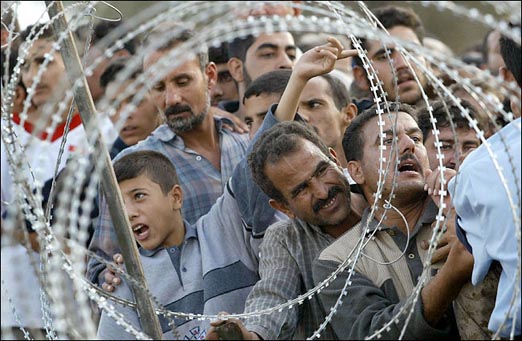
Inside the city, tens of thousands of Sunni civilians are trapped, starving and lacking medicine, according to activists and interviews with residents. Some were shot dead by the Islamic State as they tried to flee, and others died under buildings that collapsed under heavy military and militia artillery bombardment in recent days, according to the United Nations.

The few civilians who have made it to safety have escaped at night, traveling through the irrigation pipes.
extraordinary statement on Wednesday, Grand Ayatollah Ali al-Sistani, the world’s pre-eminent Shiite religious leader, who lives in Najaf in southern Iraq and is said to be concerned by Iran’s growing role in Iraq, urged security forces and militia to restrain themselves and abide by “the standard behaviors of jihad.”

The grim sectarian tableau in Falluja — starving Sunni civilians trapped in a city surrounded by a mostly Shiite force — provides the backdrop to a final assault that Iraqi officials have promised will come soon.

The United States has thousands of military personnel in Iraq and has trained Iraqi security forces for nearly two years, yet is largely on the sidelines in the battle to retake Falluja. It says its air and artillery strikes have killed dozens of Islamic State fighters, including the group’s Falluja commander. But it worries that an assault on the city could backfire — inflaming the same sectarian sentiments that have allowed the Islamic State to flourish there.

Already, as the army and militiamen battled this past week in outlying areas, taking some villages and the center of the city of Karma, to the northeast, the fight has taken on sectarian overtones.

Militiamen have plastered artillery shells with the name of Sheikh Nimr al-Nimr, a Shiite cleric close to Iran whose execution this year by Saudi Arabia, a Sunni power, deepened the region’s sectarian divide, before firing them at Falluja.

A Shiite militia leader, in a widely circulated video, is seen rallying his men with a message of revenge against the people of Falluja, whom many Iraqi Shiites believe to be Islamic State sympathizers rather than innocent civilians. Falluja is also believed to be a staging ground for suicide bombers targeting the capital, Baghdad, about 40 miles to the east. The decision to move on the city was made after several recent attacks in Baghdad killed nearly 200 people.

“Falluja is a terrorism stronghold,” said the militia leader, Aws al-Khafaji, the head of the Abu Fadhil al-Abbas militia. “It’s been the stronghold since 2004 until today.”

He continued: “There are no patriots, no real religious people in Falluja. It’s our chance to clear Iraq by eradicating the cancer of Falluja.”
 
It's odd that Hack Hussein hasn't picked up a rifle and volunteered to fight Islam, isn't it?

I'm sure he has a perfectly plausible reason why his zeal to combat Islam hasn't been translated into action.
 
Iran and the Shite militias are doing the dirty work this time,
and i'm sure the Sunni are either happy to be liberated or loathing the arrival of the Shi'a..depending
 
Iran and the Shite militias are doing the dirty work this time,
and i'm sure the Sunni are either happy to be liberated or loathing the arrival of the Shi'a..depending

The Iraqi army are involved as well, Daesh are also under pressure from Kurdish fighters east of their northern Iraqi stronghold Mosul and from U.S.-backed Kurdish-led fighters in Syria.
 
Back
Top