Russia's Implosion

I get a lot of shit for saying it but it is the truth....China is going to in....there is almost no doubt about it now.
America's future looks exceptionally bleak.
we are running the country into the ground with stuipid energy, open borders ( 3 million a year this year projected), and degrading our culture with Prog noise like 1619

China builds 1 new coal plant a week and we are constrained by Paris???
This new Biden policy imports more solar panels and hurts our existing small industry
 
Yeltsin was installed by the Russian people because he was a centerpiece for the resistance to the Soviet hardline backlash, and thus he helped the country emerge from Soviet domination.
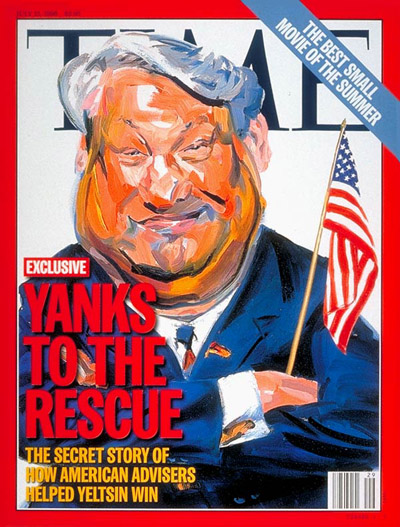
no you dont know anything. The Clinton campaign worked hard to install him.
The election was marred by allegations of voter fraud against Yeltsin and foreign interference from Clinton

1101960715_400.jpg
 
no you dont know anything. The Clinton campaign worked hard to install him.
The election was marred by allegations of voter fraud against Yeltsin and foreign interference from Clinton

1101960715_400.jpg

Did you actually read that Time story?
 
Did you actually read that Time story?
been awhile but yes/ here's a quick summary and context

U.S. Needs to Face Up to Its Long History of Election Meddling
https://www.theatlantic.com/ideas/a...s-a-long-history-of-election-meddling/565538/
Clinton liked Yeltsin personally. He considered him Russia’s best hope for embracing democracy and capitalism.
And he appreciated Yeltsin’s acquiescence during NATO’s march eastward, into the former Soviet bloc.

Unfortunately for Clinton, ordinary Russians appreciated their leader far less. Yeltsin’s “shock-therapy” economic reforms had reduced the government’s safety net, and produced a spike in unemployment and inflation. Between 1990 and 1994, the average life expectancy among Russian men had dropped by an astonishing six years.
When Yeltsin began his reelection campaign in January 1996, his approval rating stood at 6 percent, lower than Stalin’s.

So the Clinton administration sprang into action. It lobbied the International Monetary Fund to give Russia a $10 billion loan, some of which Yeltsin distributed to woo voters. Upon arriving in a given city, he often announced, “My pockets are full.”

Three American political consultants—including Richard Dresner, a veteran of Clinton’s campaigns in Arkansas—went to work on Yeltsin’s reelection bid. Every week, Dresner sent the White House the Yeltsin campaign’s internal polling. And before traveling to meet Yeltsin in April, Clinton asked Dresner what he should say in Moscow to boost his buddy’s campaign.

It worked. In a stunning turnaround, Yeltsin—who had begun the campaign in last place—defeated his communist rival in the election’s final round by 13 percentage points. Talbott declared that “a number of international observers have judged this to be a free and fair election.” But Michael Meadowcroft, a Brit who led the election-observer team of the Organization for Security and Cooperation in Europe, later claimed there had been widespread voter fraud, which he had been pressured not to expose. In Chechnya, which international observers believe contained fewer than 500,000 adults, one million people voted, and Yeltsin—despite prosecuting a brutal war in the region—won exactly 70 percent. “They’d been bombed out of existence, and there they were all supposedly voting for Yeltsin,” exclaimed Meadowcroft. “It’s like what happens in Cameroon.” Thomas Graham, who served as the chief political analyst at the U.S. embassy in Moscow during the campaign, later conceded that Clinton officials knew the election wasn’t truly fair. “This was a classic case,” he admitted, “of the ends justifying the means.”
 
As a reminder, even after adjusting for inflation, last year saw the strongest economic growth in almost four decades. Then, after the economy taking a bit of a breather in first quarter of this year, it appears to have returned to growing in the second quarter (the Blue Chip Consensus and the Atlanta Fed's calculation both suggest positive growth). Real GDP per capita is now higher than in any quarter in American history other than Q4 2021. By comparison, Russia is shrinking, economically, at a pace that is putting it back where it was 15 years ago, at least. There's really no comparison.

Tell me, how is inflation that is running at over 8%, gas prices heading for the $5 range, $8 in some areas of the country, 2 million illegal border crossings, empty grocery shelves and a lack of baby formula awesome economic news? :palm:

dumbass-dumb.gif
 
Tell me, how is inflation that is running at over 8%, gas prices heading for the $5 range, $8 in some areas of the country, 2 million illegal border crossings, empty grocery shelves and a lack of baby formula awesome economic news? :palm:

dumbass-dumb.gif

"Awesome" is your word. However, even after account for inflation, the GDP growth rate since Biden took office has been far above average, and the unemployment rate is far below average. I understand that because Biden's a Democrat that you'll cherry pick whatever indicator you can that looks negative. But, overall, things have been going well.
 
Sounds about right. They have other reasons for being unhappy with Putin and the Kremlin in general.
Did they tell you what they did foe a living back in the USSR ?

He was a university student at the time. No clue what the parents did.
 
"Awesome" is your word. However, even after account for inflation, the GDP growth rate since Biden took office has been far above average, and the unemployment rate is far below average. I understand that because Biden's a Democrat that you'll cherry pick whatever indicator you can that looks negative. But, overall, things have been going well.

How hard is it to get GDP when the economy is re-started after a nearly unprecedented shutdown ?
Point is it was not growth, it was recovery same with employment numbers.

Should the economy have been shut down ? HInd sight is 20-20 of course but the scientists said it was necessary at the time.
 
Try again. With practice, you can become a proficient reader. Good luck.

I can read your mind in what you write already- although you, apparently, cannot.


Haw, haw..............................haw.
 
How hard is it to get GDP when the economy is re-started after a nearly unprecedented shutdown ?

It can be hard. Remember, for example, that after the Crash of '29 sent the economy into a tail spin, that was followed by year after year of economic shrinkage. In fact, the economy didn't start growing again until March 1933. And that's not even the longest recession on record. It was just 43 months, whereas one US recession lasted for 65!

The reason we've become used to the idea that strong and consistent growth should follow the end of a contraction is because Fed policy made that common -- the Fed would cut rates dramatically, flooding the economy with money, and the economy would take off. But 2019 was weird. In 2019, despite very low unemployment rates and inflation rates above the Fed's target, the Fed not only failed to hike rates as it always had before in such a situation -- they actually pushed through multiple rate cuts! As a result, when the pandemic hit, there was little ability to cut rates still further, since they were already near record lows. So, this is more like those older times of 43- or 65-month-long recessions, when we couldn't count on big rate cuts. Basically, the Fed had thrown away most of its tools back in 2019, in order to try to super-heat the economy to get Trump reelected.

Also, post-COVID-shutdown weakness hasn't been uncommon. Take Germany, for example. Their real GDP shrunk in Q1 of 2021 and again in Q4 of 2021, and was virtually flat in Q1 2022 (just +0.94% annualized), such that their economy is now smaller than it was back in third quarter of last year. France was also down in Q1 2022. Japan fell in Q1 and Q3 of 2021, and again in Q1 of 2022. The idea that somehow it should be a given to have consistent and strong GDP growth after COVID lockdowns ended is something that may play well on Fox News, for obvious reasons, but it doesn't play nicely with the real-world facts. Around the world, countries are struggling to reestablish consistent growth.
 
"Awesome" is your word. However, even after account for inflation, the GDP growth rate since Biden took office has been far above average, and the unemployment rate is far below average. I understand that because Biden's a Democrat that you'll cherry pick whatever indicator you can that looks negative. But, overall, things have been going well.

deflection
passing something over to someone else in an attempt to draw the attention away from yourself. It is a psychological defense in which you deflect blame to others. When you were younger, you may have deflected the blame for a negative activity by pointing out a different negative activity your sibling did. This is to avoid dealing with negative consequences.


flailing
adjective
flail·ing | \ ˈflā-liŋ \
1: moving, swinging, or beating wildly like a flail —used especially of a person or a person's limbs
b: clumsy or ineffectual


grasping at straws

trying to find some way to succeed when nothing you choose is likely to work
 
It can be hard. Remember, for example, that after the Crash of '29 sent the economy into a tail spin, that was followed by year after year of economic shrinkage. In fact, the economy didn't start growing again until March 1933. And that's not even the longest recession on record. It was just 43 months, whereas one US recession lasted for 65!

The reason we've become used to the idea that strong and consistent growth should follow the end of a contraction is because Fed policy made that common -- the Fed would cut rates dramatically, flooding the economy with money, and the economy would take off. But 2019 was weird. In 2019, despite very low unemployment rates and inflation rates above the Fed's target, the Fed not only failed to hike rates as it always had before in such a situation -- they actually pushed through multiple rate cuts! As a result, when the pandemic hit, there was little ability to cut rates still further, since they were already near record lows. So, this is more like those older times of 43- or 65-month-long recessions, when we couldn't count on big rate cuts. Basically, the Fed had thrown away most of its tools back in 2019, in order to try to super-heat the economy to get Trump reelected.

Also, post-COVID-shutdown weakness hasn't been uncommon. Take Germany, for example. Their real GDP shrunk in Q1 of 2021 and again in Q4 of 2021, and was virtually flat in Q1 2022 (just +0.94% annualized), such that their economy is now smaller than it was back in third quarter of last year. France was also down in Q1 2022. Japan fell in Q1 and Q3 of 2021, and again in Q1 of 2022. The idea that somehow it should be a given to have consistent and strong GDP growth after COVID lockdowns ended is something that may play well on Fox News, for obvious reasons, but it doesn't play nicely with the real-world facts. Around the world, countries are struggling to reestablish consistent growth.

This isn't about a crash. it was a self inflicted shut down of the economy with devastating effects for unscientific reasons. The reality is that the economy is in freefall with potential devastating effects. Had Biden and the Democrats done NOTHING, we would be less in debt and far better off today.

grasping at straws
trying to find some way to succeed when nothing you choose is likely to work
 
Its a real shame that we dont have journalists anymore, just a very few remain....Americans by and large have not the first fucking clue what is going on....mostly they dont want to either.

Buckle Up.

There is as much good journalism in the country today as there ever was. What is lacking are readers, so many having shifted to the brain dead world of social media. You’re probably among them given the tenor and substance of your posts.
.
 
Back
Top