It is not a sign of losing a debate. You want the left to sugarcoat the oppressive right-wing gerrymandering tactics the far-right supremes made possible? The minorities and poor are losing the right to vote with oppression and the power of their vote with gerrymandering of their districts.Of late, I've noticed a trend among the Left and Democrats to reframe how they label states. It used to be red and blue states with red being Republican led and blue Democrat led.
What I am seeing is a switch by Leftists in the Democrat(ic) party to using terms like oppressor or oppressed states versus democratic ones. That is, the Left is moving towards labeling red states as "oppressive" or "fascist" and blue states as "Democratic."
It is a typical reframing by the Left when they recognize they're losing a debate. People are fleeing blue states for red ones and it's seriously threatening the Left's grip on power and gaining more power. So, they're upping the rhetoric to inflammatory levels in hopes of scaring people into voting for them.

You are using an out of date browser. It may not display this or other websites correctly.
You should upgrade or use an alternative browser.
You should upgrade or use an alternative browser.
I've noticed a trend in terminology
- Thread starter T. A. Gardner
- Start date

Grim Reaper
Chief Exit Officer (CEO)
Of late, I've noticed a trend among the Left and Democrats to reframe how they label states. It used to be red and blue states with red being Republican led and blue Democrat led.
What I am seeing is a switch by Leftists in the Democrat(ic) party to using terms like oppressor or oppressed states versus democratic ones. That is, the Left is moving towards labeling red states as "oppressive" or "fascist" and blue states as "Democratic."
It is a typical reframing by the Left when they recognize they're losing a debate. People are fleeing blue states for red ones and it's seriously threatening the Left's grip on power and gaining more power. So, they're upping the rhetoric to inflammatory levels in hopes of scaring people into voting for them.
1. People
Multiple independent sources confirm sustained net domestic migration out of Democratic‑led states and into Republican‑led states:- AP News reports that California, Illinois, and New York are shrinking, while Texas and Florida are growing rapidly.
- City Journal notes that 7 of the top 10 population‑gaining states are Republican trifectas, while 9 of the 10 biggest population‑losers are Democratic states.
- Deseret News reports a 30‑year trend of net migration from blue to red states.
- The Washington Stand cites Census data showing continued exodus from blue states and growth in red states.
- Newsweek confirms that California and New York have lost hundreds of thousands of residents since 2020, while states like Texas, Florida, and North Carolina have grown.

2. Claim: “The Left is reframing states as ‘oppressive’ vs. ‘democratic.’”
There is no evidence in the sources that Democrats or “the Left” have adopted a coordinated rhetorical shift to label red states as “oppressive” or “fascist” in any formal or widespread way.- None of the articles mention such terminology being used as an official or emerging Democratic framing.
- None describe a messaging strategy tied to migration trends.
- None support the idea that Democrats are “losing a debate” and therefore “upping rhetoric.”

Gardner’s framing shows clear ideological interpretation:
- “Leftists… are reframing because they’re losing a debate.” → This is a causal claim with no evidence provided.
- “People are fleeing blue states… threatening the Left’s grip on power.” → Migration data is real, but the political interpretation is speculative.
- “They’re upping rhetoric to scare people.” → This is an attribution of motive, not a verifiable fact.

- True: Many blue states are losing population; many red states are gaining.
- Not supported: A coordinated Democratic rhetorical shift labeling states as “oppressive vs. democratic.”
- Opinion: Claims about Democrats “losing debates,” “grip on power,” or “scaring people.”

QP!
Verified User
ahhh once again the 'fighting overt racism by focusing on the parties (PoC) being discriminated against is the racism we need to stop' comes back up.There's no such things as "reverse racism". Drawing a congressional district along racial lines is racist and unconstitutional. One of the illegally gerrymandered districts in Tennessee who had a crusty old white guy will now likely have a black woman. But you won't celebrate that because she's a Republican. Democrats can't stand uppity black folk who don't know their place.
The natural conclusion of which is 'leave the racism and power structure as is and in place and unchallenged since fighting it is racism'.

-------------
The idea that using race-conscious policies to combat racism is itself “racist” or dangerous has a long and recurring history. It tends to resurface whenever governments or institutions consider remedies that explicitly take race into account (like affirmative action, reparations, or desegregation measures). Here’s a concise historical arc of how that argument has developed and been used.
1. Early Roots: “Colorblind” Ideals vs. Reconstruction (late 1800s)
After the American Civil War, policies like the Freedmen’s Bureau were created to assist formerly enslaved Black Americans with education, housing, and legal support.
- Critics at the time argued these policies were unfair “special treatment” based on race.
- This argument helped justify rolling back Reconstruction and abandoning federal protections.
- The counter-vision that emerged—especially among white conservatives—was an early version of “colorblindness”: the idea that the law should ignore race entirely, even in a deeply unequal society.
How it was used: to oppose targeted assistance for formerly enslaved people and justify a return to racial hierarchy under formally neutral laws.
2. Jim Crow Era: “Equal Treatment” as a Defense of Inequality (late 1800s–mid 1900s)
During segregation, defenders of the system often claimed that laws applied equally to everyone, even under “separate but equal” doctrine established in Plessy v. Ferguson.
- The logic: the law doesn’t discriminate—it treats races separately but equally.
- When civil rights advocates pushed for race-conscious remedies, critics framed those as preferential or discriminatory.
How it was used: to maintain segregation while claiming neutrality, and to resist policies designed to dismantle systemic inequality.
3. Civil Rights Era Backlash (1950s–1970s)
After Brown v. Board of Education and the Civil Rights Act of 1964, the U.S. began adopting affirmative action and other race-conscious policies.
- Critics reframed opposition using a moral argument:
“Discrimination is wrong, no matter who it targets.” - This period saw the rise of “reverse discrimination” claims.
- Some politicians and legal thinkers argued that any race-based policy—even to fix inequality—violated equal protection principles.
Key evolution: The argument shifted from defending segregation to claiming that race-conscious remedies themselves perpetuate racism.
4. Legal Institutionalization (1970s–2000s)
The argument became central in court cases and constitutional law debates:
- Regents of the University of California v. Bakke
- Adarand Constructors, Inc. v. Peña
These cases advanced the idea that:
- Any race-based policy should face “strict scrutiny” (the highest legal standard).
- Even policies meant to help disadvantaged racial groups could be unconstitutional.
Prominent figures like Ronald Reagan popularized a political version of this idea, emphasizing colorblind government and opposing affirmative action.
How it was used: to limit or roll back affirmative action and other targeted remedies.
5. Modern Era: Colorblindness vs. Anti-Racism (2000s–present)
Today, the debate is often framed as:
- Colorblind approach:
Treating everyone the same, regardless of race, is the only fair and non-racist method. - Anti-racist / equity approach:
Because inequality is systemic, ignoring race can preserve disparities, so targeted policies are necessary.
The “race-conscious policy is racism” argument has been used in:
- Opposition to affirmative action (e.g., Students for Fair Admissions v. Harvard)
- Criticism of diversity, equity, and inclusion (DEI) programs
- Debates over reparations and race-based public policy
Key Insight
The core tension hasn’t changed much over time:
- One side sees any use of race in policy as inherently unjust.
- The other sees race-neutral policy as insufficient in a racially unequal system.
Historically, the “this is racism too” argument has often emerged in response to efforts aimed at reducing racial inequality, and has frequently been used to slow, limit, or block those efforts—even as its moral framing has evolved.
Grim Reaper
Chief Exit Officer (CEO)
Climate change
EV's for everyone!
Tax the shit out of the Rich and budgets will be fixed
Handouts to the poor work
Corporations are evil and must be punished
Public transit works
High speed trains are the future
High rise apartments are what people want to live in
Bike paths are vital
Solar and wind power work
Eat less meat
Criminals will stop being criminals if we talk to them politiely
Legalizing drugs will reduce use
Public education works
Unions are necessary and should be manditory
More government is good
We can start with that.
1. What Gardner posted is not a “list of debates the Left is losing.”
It’s a list of conservative caricatures of left‑leaning positions.Not one item is phrased neutrally or accurately.Not one is supported with evidence.Every item is a strawman — a distorted version of an actual policy debate.Let’s go line‑by‑line.
2. Fact‑check each claim
“Climate change”
Scientific consensus: 97%+ of climate scientists agree human‑driven climate change is real and measurable.This is not a “debate the Left is losing.”It’s a debate the scientific community has already resolved.“EVs for everyone!”
No major Democratic proposal mandates EVs for everyone.Policies focus on:- incentives
- emissions standards
- long‑term transition timelines
“Tax the rich and budgets will be fixed”
Economists across the spectrum debate tax policy.But no serious Democratic proposal claims “taxing the rich fixes everything.”This is a caricature, not a real position.“Handouts to the poor work”
Actual Democratic policies =- earned income tax credit
- child tax credit
- SNAP
- housing vouchers
“Corporations are evil and must be punished”
No mainstream Democratic platform says this.There are debates about:- antitrust enforcement
- corporate taxation
- consumer protection
“Public transit works”
This is not a left‑wing fantasy.It’s empirically true in:- NYC
- Chicago
- Tokyo
- London
- Paris
- Seoul
- Hong Kong
“High‑speed trains are the future”
In most developed countries, they already are the present.The U.S. is the outlier.“High‑rise apartments are what people want to live in”
No one claims “everyone wants high‑rises.”Urban planners argue that density reduces housing costs.That’s a market‑based argument, not ideology.“Bike paths are vital”
Cities with bike infrastructure have:- fewer traffic deaths
- lower congestion
- higher local commerce
“Solar and wind power work”
They do.They are now the cheapest new energy sources in the U.S. (per Lazard LCOE reports).This is not a losing debate — it’s an economic trend.“Eat less meat”
This is a public health and environmental recommendation, not a political mandate.Even the USDA dietary guidelines say this.“Criminals will stop being criminals if we talk to them politely”
No one believes this.This is a pure strawman.Actual debates involve:- policing strategy
- sentencing reform
- rehabilitation programs
- recidivism reduction
“Legalizing drugs will reduce use”
No major Democratic platform claims this.Arguments for legalization focus on:- reducing incarceration
- reducing black‑market violence
- regulating purity
- increasing tax revenue
“Public education works”
Public education is the backbone of every developed nation.The debate is about funding, not whether it “works.”“Unions are necessary and should be mandatory”
No mainstream Democrat proposes mandatory union membership.The actual position:- protect the right to unionize
- prevent employer retaliation
- restore collective bargaining power
“More government is good”
No party platform says this.Democrats argue for government intervention where markets fail (healthcare, infrastructure, safety nets).Republicans argue for market solutions.That’s the real debate.3. Bias Check: What Gardner is doing rhetorically
He’s using three classic techniques:1. Strawman framing
He replaces actual policy positions with exaggerated, unserious versions.2. Motive attribution
He claims the Left is “losing debates” without evidence.3. Identity‑based generalization
He treats “the Left” as a monolith with cartoonish beliefs.This is not analysis — it’s ideological venting dressed up as argument.

Ichabod Stain
Was it me?
the supremes took racism OUT of the democracy, cletus von dim.It is not a sign of losing a debate. You want the left to sugarcoat the oppressive right-wing gerrymandering tactics the far-right supremes made possible? The minorities and poor are losing the right to vote with oppression and the power of their vote with gerrymandering of their districts.
Ichabod Stain
Was it me?
1. What Gardner posted is not a “list of debates the Left is losing.”
It’s a list of conservative caricatures of left‑leaning positions.Not one item is phrased neutrally or accurately.Not one is supported with evidence.Every item is a strawman — a distorted version of an actual policy debate.
Let’s go line‑by‑line.
2. Fact‑check each claim
“Climate change”
Scientific consensus: 97%+ of climate scientists agree human‑driven climate change is real and measurable.This is not a “debate the Left is losing.”It’s a debate the scientific community has already resolved.
“EVs for everyone!”
No major Democratic proposal mandates EVs for everyone.Policies focus on:
This is a policy debate, not a “Left is losing” situation.
- incentives
- emissions standards
- long‑term transition timelines
“Tax the rich and budgets will be fixed”
Economists across the spectrum debate tax policy.But no serious Democratic proposal claims “taxing the rich fixes everything.”This is a caricature, not a real position.
“Handouts to the poor work”
Actual Democratic policies =
These are means‑tested anti‑poverty programs, not “handouts.”Evidence shows many reduce childhood poverty and increase long‑term outcomes.
- earned income tax credit
- child tax credit
- SNAP
- housing vouchers
“Corporations are evil and must be punished”
No mainstream Democratic platform says this.There are debates about:
But “corporations are evil” is rhetoric, not policy.
- antitrust enforcement
- corporate taxation
- consumer protection
“Public transit works”
This is not a left‑wing fantasy.It’s empirically true in:
Public transit is a globally proven system, not a losing debate.
- NYC
- Chicago
- Tokyo
- London
- Paris
- Seoul
- Hong Kong
“High‑speed trains are the future”
In most developed countries, they already are the present.The U.S. is the outlier.
“High‑rise apartments are what people want to live in”
No one claims “everyone wants high‑rises.”Urban planners argue that density reduces housing costs.That’s a market‑based argument, not ideology.
“Bike paths are vital”
Cities with bike infrastructure have:
This is not a losing debate; it’s a data‑supported urban planning principle.
- fewer traffic deaths
- lower congestion
- higher local commerce
“Solar and wind power work”
They do.They are now the cheapest new energy sources in the U.S. (per Lazard LCOE reports).This is not a losing debate — it’s an economic trend.
“Eat less meat”
This is a public health and environmental recommendation, not a political mandate.Even the USDA dietary guidelines say this.
“Criminals will stop being criminals if we talk to them politely”
No one believes this.This is a pure strawman.Actual debates involve:
None involve “politeness.”
- policing strategy
- sentencing reform
- rehabilitation programs
- recidivism reduction
“Legalizing drugs will reduce use”
No major Democratic platform claims this.Arguments for legalization focus on:
Again: strawman.
- reducing incarceration
- reducing black‑market violence
- regulating purity
- increasing tax revenue
“Public education works”
Public education is the backbone of every developed nation.The debate is about funding, not whether it “works.”
“Unions are necessary and should be mandatory”
No mainstream Democrat proposes mandatory union membership.The actual position:
“Mandatory unions” is fiction.
- protect the right to unionize
- prevent employer retaliation
- restore collective bargaining power
“More government is good”
No party platform says this.Democrats argue for government intervention where markets fail (healthcare, infrastructure, safety nets).Republicans argue for market solutions.That’s the real debate.
3. Bias Check: What Gardner is doing rhetorically
He’s using three classic techniques:
1. Strawman framing
He replaces actual policy positions with exaggerated, unserious versions.
2. Motive attribution
He claims the Left is “losing debates” without evidence.
3. Identity‑based generalization
He treats “the Left” as a monolith with cartoonish beliefs.
This is not analysis — it’s ideological venting dressed up as argument.
this is all framing too.
Grim Reaper
Chief Exit Officer (CEO)
There's no such things as "reverse racism". Drawing a congressional district along racial lines is racist and unconstitutional. One of the illegally gerrymandered districts in Tennessee who had a crusty old white guy will now likely have a black woman. But you won't celebrate that because she's a Republican. Democrats can't stand uppity black folk who don't know their place.
1. What actually happened in Tennessee? (Facts)
Tennessee’s congressional map was struck down because a federal court found that the legislature illegally diluted Black voting power in Memphis by splitting the city into multiple districts.Key points from the ruling (summarized):
- Memphis has a large, geographically concentrated Black population.
- The legislature cracked that population across districts in a way that reduced their ability to elect a representative of their choice.
- The court ruled this violated the Voting Rights Act and ordered a remedial map.
2. Did anyone say “red states are oppressors”?
No.The original commenter (archives) correctly pointed out that no one used that language.Countryboy is responding to a claim that wasn’t made.This is a false attribution — a rhetorical move where someone argues against a statement no one actually said.
3. Is drawing a district with a Black majority racist?
No.Creating a district that reflects the racial makeup of a city is not racist.It is often required under the Voting Rights Act to prevent minority vote dilution.What is unconstitutional is:
- cracking minority communities to weaken their voting power
- packing them excessively to limit influence elsewhere
4. Bias check on Countryboy’s comment
His reply contains several red flags:A. “Democrats can’t stand uppity black folk who don’t know their place.”
This is not an argument.It’s a racially charged insult framed as political commentary.It assigns motives to millions of people based on race and party — not evidence.B. Motive attribution
He claims Democrats oppose the candidate because she is Black and Republican.There is no evidence for this.People can oppose a candidate for policy reasons, ideology, or voting record.C. Misuse of “reverse racism”
“Reverse racism” is not a legal category.Courts evaluate racial discrimination, period — regardless of direction.D. Misrepresentation of the legal ruling
The court did not say:- “A white representative is racist”
- “A Black representative must be elected”
- The map illegally diluted Black voting power
- The district must be redrawn to comply with federal law
I've seen none, but then I don't spend my life at political websites. To the extent the main stream press uses blue and red I believe it's still liberal/conservative or left/right.Can’t say I’ve seen a lot of those who lean left describing Red States as oppressor States
However, I can see where the thinking is, not coincidental that recent gerrymandering in Blue States is done thru a lengthy process with the State’s populace having the final say via a ballot. In the Red States it is done quickly, less than a week in some States, with next to zero input from the State’s citizenry. Add in the racial factor, and it adds to the reputation
And the “fleeing” bullshit has run its course

T. A. Gardner
Serial Thread Killer
1. What Gardner posted is not a “list of debates the Left is losing.”
Google AI doesn't know what a strawman argument is. That aside, I made a list of topics without commentary so Google AI's (nothing here is the work of Grimmy so the rebuttal is to Google AI) characterization of the list as "conservative caricatures" is bullshit.
2. Fact‑check each claim
“Climate change”
This is an irrelevant appeal to authority that has been trotted out for decades. Clearly, the predictions of climate change, climate crisis, etc., as portrayed primarily on the Left have been wrong and badly wrong. A psychic could make better predictions.
Most people will agree that climate change occurs. I say it does too. Where the argument from the Left falls apart is with putting that onus on CO2 as the primary or only cause of that change. There, no consensus exists outside the true believers on the Left and among climate scientists who have a vested interest in keeping their research going--they don't want to lose their jobs.
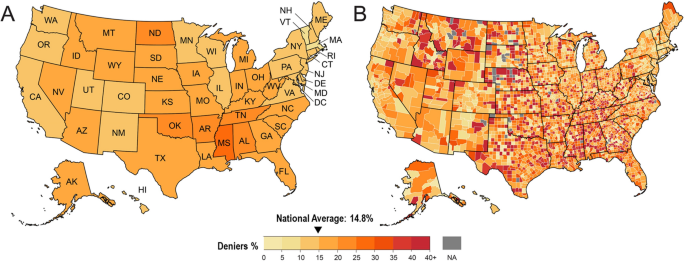
The social anatomy of climate change denial in the United States - Scientific Reports
Using data from Twitter (now X), this study deploys artificial intelligence (AI) and network analysis to map and profile climate change denialism across the United States. We estimate that 14.8% of Americans do not believe in climate change. This denialism is highest in the central and southern...
 www.nature.com

Why Some Americans Do Not See Urgency on Climate Change
As the Earth’s temperature continues to rise, climate change remains a lower priority for some Americans, and a subset of the public rejects that it’s happening at all. To better understand the perspectives of those who see less urgency to address climate change, the Center conducted a series of...
 www.pewresearch.org
The Left can only 'Cry wolf!' so many times before no one believes them.
“EVs for everyone!”
I used hyperbole here, something Google AI doesn't understand at all. That aside, yes there are major Democrat policies that mandate EV's

EPA Green-Lights California's Plan to End Sales of New ICE Cars by 2035
The Trump administration could ultimately strike down the approval, however.
 www.roadandtrack.com

12 US States Are Planning to Ban the Sale of Gas-Powered Cars
To curb tailpipe emissions and boost EV and plug-in hybrid sales, California is working toward banning the purchase of combustion cars. Eleven more US states announced plans to follow suit.
 www.cnet.com
Those are EV mandates. They ban alternatives. They were passed into law by Democrats. It isn't a "policy debate," it IS policy.
“Tax the rich and budgets will be fixed”
I didn't address this to "economists." I stated that Democrats and the Left think that you can tax big corporations and The Rich and find sufficient money to cover huge current budget deficits and if not entirely, will go a long way to that end.

Taxing the Rich Could Raise Trillions — But That Alone Won’t Fix Our Fiscal Crisis
A new paper from Manhattan Institute’s Brian Riedl examines ways to raise revenue from high-income Americans.
 www.pgpf.org

These Democrats are trying to raise taxes on the wealthiest Americans. Here's what they want.
The proposal comes on the heels of President Joe Biden's budget request, which also included higher taxes on a narrower set of wealthy Americans.
www.usatoday.com
Democrats Get Serious About Taxing the Rich - The American Prospect
Democrats are beginning to reshape taxes to account for the massive redistribution upward of wealth and income that the nation has experienced since 1980.
 prospect.org
“Handouts to the poor work”
Actual Democratic policies =
hand·out
[ˈhandaʊt]
noun
handout (noun)
handouts (plural noun)
hand-out (noun)
hand-outs (plural noun)
- a quantity of financial or other material aid given to a person or organization:
So, yes, Democrat policies are "handouts to the poor."
“Corporations are evil and must be punished”
More hyperbole Google AI doesn't understand.
“Public transit works”
This is not a left‑wing fantasy.It’s empirically true in:
- NYC
- Chicago
- Tokyo
- London
- Paris
- Seoul
- Hong Kong
All those systems also run at a deficit. Not one system breaks even or generates a profit. Public transit, as it exists, doesn't work.
“High‑speed trains are the future”
Same thing. Almost all high-speed rail systems run at a major deficit. China's system is essentially going bankrupt. In the US, HSR cannot compete with airlines for cost effectiveness, efficiency, or flexibility.
“High‑rise apartments are what people want to live in”
"Everyone" is hyperbole.

FACT SHEET: President Biden Announces Major New Actions to Lower Housing Costs by Limiting Rent Increases and Building More Homes | The White House
President Biden calls on corporate landlords to cap rent increases at 5% and takes action to make more public land available for housing President Biden
2024 Democratic Party Platform | The American Presidency Project
 www.presidency.ucsb.edu
In LBJ's day, the Democrats pushed public housing in the form of high-rise buildings. That ended with the Watts riots.
Urban planners are obviously idiots. As urban density rises the cost per square foot of housing rises.
“Bike paths are vital”
Cities with bike infrastructure have:
This is not a losing debate; it’s a data‑supported urban planning principle.
More hyperbole.
Bike paths are NOT vital. Most go largely or entirely unused. None of Google AI's conclusions can be supported by reasonable data.

Why Bike Lanes Aren’t Enough: The Dangers Cyclists Still Face on U.S. Roads - Safety Info.org
Across the United States, cities have invested heavily in building bike lanes and promoting cycling as a clean, healthy mode of transportation. On paper, it looks like progress. More protected lanes, more cyclists, fewer emissions. Yet the data tells a harsher story: despite new infrastructure...
 www.safetyinfo.org
In the Phoenix metro area where I live bicycling is largely out of the question much of the year due to climate for example.
“Solar and wind power work”
They do.They are now the cheapest new energy sources in the U.S. (per Lazard LCOE reports).This is not a losing debate
Name one country or state where the cost of energy was reduced after heavy commitment to solar and wind. Solar and wind cause massive increases in the cost of electricity when applied to the grid because the way the LCOE is calculated doesn't account for them being intermittent sources.
“Eat less meat”
This is a public health and environmental recommendation, not a political mandate.Even the USDA dietary guidelines say this.

The left’s stupid, politicized war against meat
There are three reasons why limiting your consumption of red meat is a good thing: It’s better for you, it’s better for animals, and it’s better for the environment. Those are all in…
 nypost.com



Meat Eating and Political Ideology
New numbers out by Gallup show that Americans from the left and right are also divided in meat consumption.
 www.psychologytoday.com
Google AI, as usual, is wrong.
“Criminals will stop being criminals if we talk to them politely”
No one believes this.This is a pure strawman.Actual debates involve:
None involve “politeness.”
More hyperbole.
It isn't a "strawman" because it is hyperbole.
And the Left is against:
Mandatory minimum sentences
Increased policing
Restrictions on bail
Death penalty
“Legalizing drugs will reduce use”
No major Democratic platform claims this.Arguments for legalization focus on:
Again: strawman.
And the results after trying just that:
“Public education works”
Public education is the backbone of every developed nation.The debate is about funding, not whether it “works.”

Voters demand school choice for their kids. So why aren't Democrats embracing it?
Democrats haven't been bold enough in one critical area and it's costing us politically. We must embrace school choice and invest in public schools.
www.usatoday.com

Democrats Oppose Opportunity Scholarships
The party explicitly rejects the school-choice program in its 2024 platform.
 www.city-journal.org
Public education (run by government) is widely seen as poor quality and ineffective. Democrats oppose alternatives that are being shown to work better.
“Unions are necessary and should be mandatory”
No mainstream Democrat proposes mandatory union membership.The actual position:
“Mandatory unions” is fiction.
Hyperbole, that thing Google AI doesn't understand.
Democrats also support:
Card checks for unionization
Reduction of Beck rights
Democrats Reintroduce Sweeping Bill To Strengthen Unions
WASHINGTON – Congressional Democrats on Wednesday reintroduced the Protecting the Right to Organize Act, or PRO Act, a sweeping bill aimed at boosting union membership after decades of decline.The legislation, led this year by Sen. Bernie Sanders (I-Vt.) and Rep. Bobby Scott (D-Va.), would...
 bobbyscott.house.gov
“More government is good”
No party platform says this.Democrats argue for government intervention where markets fail (healthcare, infrastructure, safety nets).Republicans argue for market solutions.That’s the real debate.
Hyperbole but true. Actions speak louder than words. Google AI tries to weasel out of this one by claiming nothing in writing shows it.
3. Bias Check: What Gardner is doing rhetorically
He’s using three classic techniques:
1. Strawman framing
No strawmans were made. Instead, I employed hyperbole backed by examples.
2. Motive attribution
The losing part is seen in the flight of people from blue states to red ones, as one example.
3. Identity‑based generalization
This is not analysis — it’s ideological venting dressed up as argument.
No, I don't. I know the Left isn't completely in lockstep. On the other hand, Google AI makes excuses using tired and disproven arguments to try and frame what I posted in a negative way. Once again, Google AI shows it can't think.
Grim Reaper
Chief Exit Officer (CEO)
Google AI doesn't know what a strawman argument is. That aside, I made a list of topics without commentary so Google AI's (nothing here is the work of Grimmy so the rebuttal is to Google AI) characterization of the list as "conservative caricatures" is bullshit.
| Topic / move | Verdict (fact) | Bias / rhetoric note |
|---|---|---|
| “Google AI doesn’t know what a strawman is” | False / rhetorical | You’re using strawmen and hyperbole. |
| Climate change & CO₂ | Scientific consensus misrepresented | Strong consensus CO₂ is main driver. |
| “EVs for everyone” / mandates | Partly true, partly exaggerated | Real mandates, but not universal or Dem‑only. |
| “Tax the rich will fix budgets” | Accurate criticism | Serious Dems don’t claim it fully fixes deficits. |
| “Handouts to the poor work” | Loaded framing | Real programs; “handout” is ideological language. |
| Public transit “doesn’t work” | Misleading | Often subsidized, but high ridership & benefits. |
| HSR “can’t compete” / “going bankrupt” | Overstated | Mixed record; some systems successful, some not. |
| High‑rise housing / density | Economics oversimplified | Density usually lowers per‑unit cost, not raises. |
| Bike paths “not vital, mostly unused” | Contradicted by data | Many cities show high use & safety benefits. |
| Solar/wind “raise costs everywhere” | Factually wrong in key cases | Some high‑renewable grids have lower prices. |
| “Left thinks criminals stop if we’re polite” | Classic strawman | No mainstream platform says this. |
| Drugs: “legalizing reduces use” | You’re right that results are mixed | Oregon is a real cautionary example. |
| Public education “doesn’t work” | Overgeneralization | Outcomes uneven; Dems do resist some choice models. |
| Unions “necessary and should be mandatory” | Strawman + hyperbole | Dems support easier unionizing, not mandatory unions. |
| “More government is good” | Hyperbolic caricature | Not a stated position; inferred from policy prefs. |
1. Strawman vs hyperbole
A strawman is when you distort or exaggerate an opponent’s position and then attack that distorted version instead of what they actually believe.Hyperbole doesn’t magically exempt you from that. If you say things like:
or“Criminals will stop being criminals if we talk to them politely”
you’re doing exactly what the definition describes: presenting a more extreme, simplified version of “the Left” to knock down. That is a strawman, even if you call it hyperbole.“Unions are necessary and should be mandatory”
So the claim “No strawmans were made. Instead, I employed hyperbole backed by examples.” is not defensible. Hyperbole can be—and here often is—the vehicle for strawman framing.
2. Climate change, CO₂, and “crying wolf”
You write:That’s just factually wrong about the state of the science. Multiple assessments (IPCC, national academies, etc.) conclude that human‑caused greenhouse gases, especially CO₂, are the dominant driver of recent warming.“Most people will agree that climate change occurs. I say it does too. Where the argument from the Left falls apart is with putting that onus on CO2 as the primary or only cause of that change. There, no consensus exists…”
The Nature article you linked is about denialism on X/Twitter, not about scientific uncertainty over CO₂. It actually presupposes the scientific consensus and studies why some people reject it.
The Pew piece you linked is about public attitudes and why some Americans don’t see urgency, not about the underlying physics.
So:
- Appeal to authority? Citing expert consensus in a technical domain is not a fallacy by itself; it’s how we handle complex science.
- “Predictions have been badly wrong”? Some specific media‑level predictions have been off, but core projections (warming trend, sea‑level rise, more extremes) have been broadly in line with models.
3. EV mandates and “EVs for everyone”
You’re right that there are real policy mandates:- California’s rule to end sales of new gasoline‑only cars by 2035, with EPA approval.
- A group of other states following California’s standards.
- These rules don’t ban existing gas cars, and usually still allow plug‑in hybrids or other low‑emission vehicles.
- They’re state‑level, not “Democrats everywhere want EVs for everyone immediately.”
4. “Tax the rich and budgets will be fixed”
The PGPF piece you cite explicitly says:That actually supports the more nuanced view: taxing the rich can meaningfully narrow the gap, but not fully close it given entitlement and spending trajectories.“Taxing the rich could raise trillions — but that alone won’t fix our fiscal crisis.”
Progressive Democrats do push wealth taxes, higher top rates, and corporate minimums.
So:
- Your fair point: Some political rhetoric oversells how far “tax the rich” goes toward fixing deficits.
- Your overreach: Framing it as “Democrats think this fixes budgets” ignores that many policy papers and serious Dems openly acknowledge it’s only part of the solution.
5. “Handouts to the poor”
You lean on the dictionary:That’s a normative framing, not a factual discovery. Programs like SNAP, Medicaid, housing vouchers, EITC, etc. are:“Those receiving them did nothing to earn them. They produced nothing in return for receiving those benefits. That makes them handouts.”
- Means‑tested transfers with documented effects on poverty, health, and long‑term outcomes for children.
6. Public transit “doesn’t work” because it runs a deficit
You say:Most major systems (NYC, London, Paris, Tokyo, etc.) do require subsidy—that’s true.“All those systems also run at a deficit. Not one system breaks even or generates a profit. Public transit, as it exists, doesn't work.”
But “doesn’t work” is a category error:
- Transit is treated as infrastructure/public service, like roads, which also don’t “turn a profit.”
- Systems in cities like Tokyo, Hong Kong, and Seoul move huge shares of commuters and are essential to economic functioning.
7. High‑speed rail
You claim:Reality is mixed:“Almost all high-speed rail systems run at a major deficit. China's system is essentially going bankrupt. In the US, HSR cannot compete with airlines…”
- Some lines (e.g., Japan’s Tokaido Shinkansen, certain French TGV routes) are operationally profitable and heavily used.
- Many systems require large capital subsidies and some routes are financial losers.
- China’s HSR network is heavily indebted, but “essentially going bankrupt” is an overstatement; it’s more a question of long‑term debt sustainability and state backing.
Grim Reaper
Chief Exit Officer (CEO)
8. Density, high‑rises, and housing costs
You say:Empirically:“Urban planners are obviously idiots. As urban density rises the cost per square foot of housing rises.”
- Land price per square foot rises with centrality and demand.
- But per‑unit housing cost can fall with more units on the same land (i.e., density is how you fight high land costs).
So your “as density rises, cost per square foot rises” is mixing land economics with unit economics. The serious debate is about how to add density without displacing low‑income residents, not whether density inherently makes housing unaffordable.
9. Bike paths “not vital” and “mostly unused”
You write:The article you cite is about bike lanes not being sufficient for safety, not about them being useless.“Bike paths are NOT vital. Most go largely or entirely unused. None of Google AI's conclusions can be supported by reasonable data.”
Data from multiple cities show:
- Protected bike lanes increase cycling volumes and reduce injuries.
- Cities with strong bike infrastructure (Copenhagen, Amsterdam, parts of NYC, etc.) see very high usage.
10. Solar, wind, and electricity prices
You ask:Examples:“Name one country or state where the cost of energy was reduced after heavy commitment to solar and wind.”
- In the U.S., Lazard’s LCOE analyses show new utility‑scale solar and wind are among the cheapest new generation sources.
- Countries like Denmark and Germany did see higher retail prices during early renewables build‑out, but more recent cases (e.g., Texas wholesale markets, parts of Spain and Portugal) show periods of very low wholesale prices driven by high renewables penetration.
11. Meat, politics, and “the Left’s war on meat”
The pieces you cite (NY Post, The Atlantic, Psychology Today) show:- There is a cultural and political divide on meat consumption and climate.
- But the USDA guidelines recommending more plant‑forward diets are framed as health guidance, not a partisan mandate.
12. Crime, “politeness,” and drug policy
You say:Mainstream Democrats do:“It isn't a ‘strawman’ because it is hyperbole. And the Left is against: Mandatory minimum sentences, Increased policing, Restrictions on bail, Death penalty”
- Oppose many mandatory minimums and support bail reform.
- Have a more mixed record on policing (some “defund” rhetoric, but also many Dem mayors increasing police budgets).
On drugs:
- The Johns Hopkins report and Oregon experience show real problems with poorly implemented decriminalization.
- Your Axios link about Portland walking back policy is accurate and a legitimate critique.
13. Public education and school choice
You argue:The links you provide show:“Public education (run by government) is widely seen as poor quality and ineffective. Democrats oppose alternatives that are being shown to work better.”
- Some Democrats urging the party to embrace more school choice.
- Others opposing voucher‑style programs (e.g., Opportunity Scholarships) in the party platform.
Your political point (Dems often protect the existing system and unions) is fair; the blanket dismissal of public education is rhetorical.
14. Unions, PRO Act, and “mandatory”
You say:The PRO Act does:“‘Mandatory unions’ is fiction. Hyperbole, that thing Google AI doesn't understand. Democrats also support: Card checks for unionization, Reduction of Beck rights”
- Make unionization easier (card check, penalties for employer interference).
- Limit right‑to‑work style rules and narrow some opt‑out rights.
15. “More government is good” and migration from blue to red
“More government is good” is not in any platform; it’s your inference from policy preferences. That’s fine as interpretation, but not as a literal claim about what “the Left” says.On migration:
- There has been net domestic migration from some high‑tax blue states (CA, NY, IL) to red or purple states (TX, FL, AZ, etc.) in recent years.
- Reasons include housing costs, taxes, remote work, and climate—not just “Left is losing.”
Bottom line
You do have some solid substantive points (EV mandates exist; tax‑the‑rich doesn’t fully fix deficits; Oregon’s drug policy flop; Dem resistance to vouchers; real concerns about grid integration of renewables).But a lot of your framing does exactly what “strawman” means: exaggerating opponents’ positions into something dumber or more extreme, then declaring victory. Calling it “hyperbole” doesn’t change that.

Half your shit is anti alternative energy listed over and over again. And you don't give a shit about less government. You'd be complaining about Republicans expansion of Homeland Security.Climate change
EV's for everyone!
Tax the shit out of the Rich and budgets will be fixed
Handouts to the poor work
Corporations are evil and must be punished
Public transit works
High speed trains are the future
High rise apartments are what people want to live in
Bike paths are vital
Solar and wind power work
Eat less meat
Criminals will stop being criminals if we talk to them politiely
Legalizing drugs will reduce use
Public education works
Unions are necessary and should be manditory
More government is good
We can start with that.
You just hate Democrats.
T. A. Gardner
Serial Thread Killer
No, it isn't. I want what works. Solar and wind don't work. Nuclear does. I can demonstrate clearly solar and wind don't work both by example and historical data.Half your shit is anti alternative energy listed over and over again. And you don't give a shit about less government. You'd be complaining about Republicans expansion of Homeland Security.
You just hate Democrats.
I do despise the Left. I don't "hate Democrats."

Noking
Fight authoritarianism support Noking
BFDOf late, I've noticed a trend among the Left and Democrats to reframe how they label states. It used to be red and blue states with red being Republican led and blue Democrat led.
What I am seeing is a switch by Leftists in the Democrat(ic) party to using terms like oppressor or oppressed states versus democratic ones. That is, the Left is moving towards labeling red states as "oppressive" or "fascist" and blue states as "Democratic."
It is a typical reframing by the Left when they recognize they're losing a debate. People are fleeing blue states for red ones and it's seriously threatening the Left's grip on power and gaining more power. So, they're upping the rhetoric to inflammatory levels in hopes of scaring people into voting for them.
T. A. Gardner
Serial Thread Killer
Oh, I'll bother to respond to Grimmy when I choose or if she actually decides to participate in the debate rather than spend 30 seconds getting Google AI to do ALL OF HER HOMEWORK. I don't particularly want to debate a stupid computer program.

Into the Night
Contributor
It's the same old inversion fallacy. They blame their fascism and communism that they want on everybody else.Of late, I've noticed a trend among the Left and Democrats to reframe how they label states. It used to be red and blue states with red being Republican led and blue Democrat led.
What I am seeing is a switch by Leftists in the Democrat(ic) party to using terms like oppressor or oppressed states versus democratic ones. That is, the Left is moving towards labeling red states as "oppressive" or "fascist" and blue states as "Democratic."
It is a typical reframing by the Left when they recognize they're losing a debate. People are fleeing blue states for red ones and it's seriously threatening the Left's grip on power and gaining more power. So, they're upping the rhetoric to inflammatory levels in hopes of scaring people into voting for them.
Into the Night
Contributor
It is DEMOCRATS that are oppressive.Or they could just be using realistic terms to refer to red states.
It is DEMOCRATS the arrested people for simply walking on a beach alone during the Covid Hoax.
It is DEMOCRATS raising taxes.
It is DEMOCRATS that are overregulating businesses, causing them to flee.
It is DEMOCRATS that want to force States to allow the murder of children.
It is DEMOCRATS that want to ban or limit guns.
It is DEMOCRATS that want to discard the Constitution of the United States and all State constitutions.
It is DEMOCRATS that are rioting in the streets.
It is DEMOCRATS that support insurrection.
It is DEMOCRATS that support criminal activity and organized crime.
It is DEMOCRATS that are conducting federal fraud.
It is DEMOCRATS that allow open looting.
It is DEMOCRATS that commit election fraud.
It is DEMOCRATS that don't want elections.
It is DEMOCRATS that assassinate people and have attempted to assassinate Trump multiple times.
It is DEMOCRATS that want to practice sexual deviancy and call it "normal".
It is DEMOCRATS that committed treason by giving weapons and supplies to the enemy in time of war, and invited invasion of the United States.
It is DEMOCRATS that harbor illegal aliens.
It is DEMOCRATS implementing communism and fascism.
It is DEMOCRATS that are racists and bigots.
Fuck you, Stooge.
Into the Night
Contributor
No, Stooge. I don't like paying oppressive taxes levied by Democrats on gas."Losing the debate"? LOLOL - what's the debate question: "How do you like paying $6 for gas"? Answer: Democrat: "I hate it" Trump voter: "What's gas?".
Carbon taxes are unconstitutional. Religions are banned from having taxing authority.
Into the Night
Contributor
You are being racist again, anchovies.But she did not say red states were the oppressors now did she, and just to educate you, Memphis electing a black representative wasn’t reverse racism, the city is 65% black, duh
Into the Night
Contributor
You are being racist again, anchovies.One could use Memphis as an example, it is an urban center, 65% Black, and now, purposely, that voting block is spread out amongst three heavily white rural districts. Sure appears Tennessee is trying to oppress the Black and urban vote